


Page 34 - MGPI_Case_Study
P. 34
156
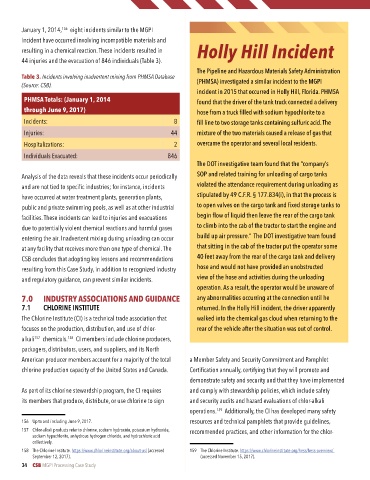
        January 1, 2014,   eight incidents similar to the MGPI
        incident have occurred involving incompatible materials and
                                                                  Holly Hill Incident
        resulting in a chemical reaction. These incidents resulted in
        44 injuries and the evacuation of 846 individuals (Table 3).
                                                                  The Pipeline and Hazardous Materials Safety Administration
        Table 3. Incidents involving inadvertent mixing from PHMSA Database
        (Source: CSB).                                            (PHMSA) investigated a similar incident to the MGPI
                                                                  incident in 2015 that occurred in Holly Hill, Florida. PHMSA
         PHMSA Totals: (January 1, 2014                           found that the driver of the tank truck connected a delivery
         through June 9, 2017)                                    hose from a truck filled with sodium hypochlorite to a
         Incidents:                                        8      fill line to two storage tanks containing sulfuric acid. The

         Injuries:                                        44      mixture of the two materials caused a release of gas that
         Hospitalizations:                                 2      overcame the operator and several local residents.

         Individuals Evacuated:                          846
                                                                  The DOT investigative team found that the “company’s
                                                                  SOP and related training for unloading of cargo tanks
        Analysis of the data reveals that these incidents occur periodically
                                                                  violated the attendance requirement during unloading as
        and are not tied to specific industries; for instance, incidents
                                                                  stipulated by 49 C.F.R. § 177.834(i), in that the process is
        have occurred at water treatment plants, generation plants,
                                                                  to open valves on the cargo tank and fixed storage tanks to
        public and private swimming pools, as well as at other industrial
                                                                  begin flow of liquid then leave the rear of the cargo tank
        facilities. These incidents can lead to injuries and evacuations
                                                                  to climb into the cab of the tractor to start the engine and
        due to potentially violent chemical reactions and harmful gases
                                                                  build up air pressure.”  The DOT investigative team found
        entering the air. Inadvertent mixing during unloading can occur
                                                                  that sitting in the cab of the tractor put the operator some
        at any facility that receives more than one type of chemical. The
                                                                  40 feet away from the rear of the cargo tank and delivery
        CSB concludes that adopting key lessons and recommendations
                                                                  hose and would not have provided an unobstructed
        resulting from this Case Study, in addition to recognized industry
                                                                  view of the hose and activities during the unloading
        and regulatory guidance, can prevent similar incidents.
                                                                  operation. As a result, the operator would be unaware of
        7.0    INDUSTRY ASSOCIATIONS AND GUIDANCE                 any abnormalities occurring at the connection until he

        7.1    CHLORINE INSTITUTE                                 returned. In the Holly Hill incident, the driver apparently
        The Chlorine Institute (CI) is a technical trade association that   walked into the chemical gas cloud when returning to the
        focuses on the production, distribution, and use of chlor-  rear of the vehicle after the situation was out of control.
        alkali   chemicals.   CI members include chlorine producers,
            157
                       158
        packagers, distributors, users, and suppliers, and its North
        American producer members account for a majority of the total   a Member Safety and Security Commitment and Pamphlet
        chlorine production capacity of the United States and Canada.   Certification annually, certifying that they will promote and
                                                                demonstrate safety and security and that they have implemented
        As part of its chlorine stewardship program, the CI requires   and comply with stewardship policies, which include safety
        its members that produce, distribute, or use chlorine to sign   and security audits and hazard evaluations of chlor-alkali
                                                                         159
                                                                operations.   Additionally, the CI has developed many safety
        156  Up to and including June 9, 2017.                  resources and technical pamphlets that provide guidelines,
        157  Chlor-alkali products refer to chlorine, sodium hydroxide, potassium hydroxide,   recommended practices, and other information for the chlor-
            sodium hypochlorite, anhydrous hydrogen chloride, and hydrochloric acid
            collectively.
        158  The Chlorine Institute. https://www.chlorineinstitute.org/about-us/ (accessed   159  The Chlorine Institute. https://www.chlorineinstitute.org/hess/hess-overview/
            September 12, 2017).                                   (accessed November 15, 2017).
        34  CSB MGPI Processing Case Study

