


Page 39 - MGPI_Case_Study
P. 39
In 2014, with input from OSHA and EPA, PHMSA issued     roles and responsibilities for valve operation might not have
        the “Cargo Tank Motor Vehicle (CTMV) Loading/Unloading   been switched between facility personnel and CTMV drivers,
        Operations: Recommended Best Practices Guide” (PHMSA    and critical steps missing from the procedures could have
              194
                                                                                        199
        Guide).   PHMSA, at the same time, published a two-     been identified and corrected.   In addition, MGPI might
        page companion pocket guide (PHMSA Companion Guide)     have identified the incorrect pipe marking at Mod B and lack
                                                                                                       200
        to serve as a reference for chemical delivery drivers.   of signs or pipe markers at the connection points.   PHMSA
                                                                states that employers should use these risk assessments to
                                                                                                               201
        The PHMSA Guide provides various best practices for training,   implement new, or enhance existing, operating procedures.
        conducting risk assessments and audits, and implementing
        clear operating procedures based on those assessments and   Prior to the incident, both Harcros’ and MGPI’s procedures
              195
        audits.   PHMSA recommends that all hazmat employees,   required verification that material is being transferred into
        whether employed by a carrier or facility, be evaluated annually   the appropriate tank and that the tank has sufficient room
        to gauge their understanding of safe loading/unloading   to receive the chemical; however, both procedures relied on
        procedures.   Employees should also be observed and     oral communication between the driver and operator. Certain
                  196
        evaluated and feedback provided on the performance of their   design issues, such as adding distance between incompatible

        duties.   The CSB found that neither MGPI nor Harcros had   connections, selecting unique fittings, and applying clearer
              197
        a program or process for evaluating and providing feedback   pipe markings, could greatly reduce the likelihood of incorrect
        to Mod B employees performing unloading operations or   connections. The PHMSA Guide also suggests implementing
        Harcros drivers. Had MGPI and Harcros actively monitored   engineering controls to avoid the mixture of incompatible
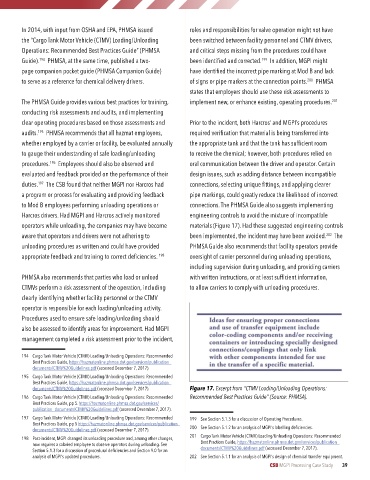
        operators while unloading, the companies may have become   materials (Figure 17). Had these suggested engineering controls
                                                                                                             202
        aware that operators and drivers were not adhering to   been implemented, the incident may have been avoided.   The
        unloading procedures as written and could have provided   PHMSA Guide also recommends that facility operators provide
                                                      198
        appropriate feedback and training to correct deficiencies.     oversight of carrier personnel during unloading operations,
                                                                including supervision during unloading, and providing carriers

        PHMSA also recommends that parties who load or unload   with written instructions, or at least sufficient information,
        CTMVs perform a risk assessment of the operation, including   to allow carriers to comply with unloading procedures.
        clearly identifying whether facility personnel or the CTMV
        operator is responsible for each loading/unloading activity.
        Procedures used to ensure safe loading/unloading should
        also be assessed to identify areas for improvement. Had MGPI
        management completed a risk assessment prior to the incident,


        194  Cargo Tank Motor Vehicle (CTMV) Loading/Unloading Operations: Recommended
            Best Practices Guide, https://hazmatonline.phmsa.dot.gov/services/publication_
            documents/CTMV%20Guidelines.pdf (accessed December 7, 2017).
        195  Cargo Tank Motor Vehicle (CTMV) Loading/Unloading Operations: Recommended
            Best Practices Guide, https://hazmatonline.phmsa.dot.gov/services/publication_
            documents/CTMV%20Guidelines.pdf (accessed December 7, 2017).  Figure 17. Excerpt from “CTMV Loading/Unloading Operations:
        196  Cargo Tank Motor Vehicle (CTMV) Loading/Unloading Operations: Recommended   Recommended Best Practices Guide” (Source: PHMSA).
            Best Practices Guide, pp 5. https://hazmatonline.phmsa.dot.gov/services/
            publication_documents/CTMV%20Guidelines.pdf (accessed December 7, 2017).
        197  Cargo Tank Motor Vehicle (CTMV) Loading/Unloading Operations: Recommended   199  See Section 5.1.3 for a discussion of Operating Procedures.
            Best Practices Guide, pp 5 https://hazmatonline.phmsa.dot.gov/services/publication_
            documents/CTMV%20Guidelines.pdf (accessed December 7, 2017).  200  See Section 5.1.2 for an analysis of MGPI’s labelling deficiencies.
                                                                201  Cargo Tank Motor Vehicle (CTMV) Loading/Unloading Operations: Recommended
        198  Post-incident, MGPI changed its unloading procedure and, among other changes,
            now requires a salaried employee to observe operators during unloading. See   Best Practices Guide, https://hazmatonline.phmsa.dot.gov/services/publication_
            Section 5.1.3 for a discussion of procedural deficiencies and Section 9.0 for an   documents/CTMV%20Guidelines.pdf (accessed December 7, 2017).
            analysis of MGPI’s updated procedures.              202  See Section 5.1.1 for an analysis of MGPI’s design of chemical transfer equipment.
                                                                                          CSB MGPI Processing Case Study   39

