


Page 203 - D&D 5e - SRD
P. 203
    Huge	   and	   Gargantuan	   Objects.	   Normal	   weapons
             Objects                                               are	   of	   little	   use	   against	   many	   Huge	   and	   Gargantuan
             When	   characters	   need	   to	   saw	   through	   ropes,	   shatter	     objects,	   such	   as	   a	   colossal	   statue,	   towering	   column	   of
             a	   window,	   or	   smash	   a	   vampire’s	   coffin,	   the	   only	   hard	     stone,	   or	   massive	   boulder.	   That	   said,	   one	   torch	   can
             and	   fast	   rule	   is	   this:	   given	   enough	   time	   and	   the	   right	     burn	   a	   Huge	   tapestry,	   and	   an	   earthquake	   spell	   can
             tools,	   characters	   can	   destroy	   any	   destructible	   object.	     reduce	   a	   colossus	   to	   rubble.	   You	   can	   track	   a	   Huge	   or
             Use	   common	   sense	   when	   determining	   a	   character’s	     Gargantuan	   object’s	   hit	   points	   if	   you	   like,	   or	   you	   can
             success	   at	   damaging	   an	   object.	   Can	   a	   fighter	   cut	     simply	   decide	   how	   long	   the	   object	   can	   withstand
             through	   a	   section	   of	   a	   stone	   wall	   with	   a	   sword?	   No,	     whatever	   weapon	   or	   force	   is	   acting	   against	   it.	   If	   you
             the	   sword	   is	   likely	   to	   break	   before	   the	   wall	   does.	     track	   hit	   points	   for	   the	   object,	   divide	   it	   into	   Large	   or
             	    For	   the	   purpose	   of	   these	   rules,	   an	   object	   is	   a	     smaller	   sections,	   and	   track	   each	   section’s	   hit	   points
             discrete,	   inanimate	   item	   like	   a	   window,	   door,	   sword,	     separately.	   Destroying	   one	   of	   those	   sections	   could
             book,	   table,	   chair,	   or	   stone,	   not	   a	   building	   or	   a	     ruin	   the	   entire	   object.	   For	   example,	   a	   Gargantuan
             vehicle	   that	   is	   composed	   of	   many	   other	   objects.	     statue	   of	   a	   human	   might	   topple	   over	   when	   one	   of	   its
                                                                   Large	   legs	   is	   reduced	   to	   0	   hit	   points.
             Statistics for Objects                                	    Objects	   and	   Damage	   Types.	   Objects	   are	   immune
             When	   time	   is	   a	   factor,	   you	   can	   assign	   an	   Armor	   Class	     to	   poison	   and	   psychic	   damage.	   You	   might	   decide	   that
             and	   hit	   points	   to	   a	   destructible	   object.	   You	   can	   also	     some	   damage	   types	   are	   more	   effective	   against	   a
             give	   it	   immunities,	   resistances,	   and	   vulnerabilities	   to	     particular	   object	   or	   substance	   than	   others.	   For
             specific	   types	   of	   damage.	                   example,	   bludgeoning	   damage	   works	   well	   for
             	    Armor	   Class.	   An	   object’s	   Armor	   Class	   is	   a	   measure	     smashing	   things	   but	   not	   for	   cutting	   through	   rope	   or
             of	   how	   difficult	   it	   is	   to	   deal	   damage	   to	   the	   object	     leather.	   Paper	   or	   cloth	   objects	   might	   be	   vulnerable
             when	   striking	   it	   (because	   the	   object	   has	   no	   chance	   of	     to	   fire	   and	   lightning	   damage.	   A	   pick	   can	   chip	   away
             dodging	   out	   of	   the	   way).	   The	   Object	   Armor	   Class	     stone	   but	   can’t	   effectively	   cut	   down	   a	   tree.	   As	   always,
             table	   provides	   suggested	   AC	   values	   for	   various	     use	   your	   best	   judgment.
             substances.	                                          	    Damage	   Threshold.	   Big	   objects	   such	   as	   castle
                                                                   walls	   often	   have	   extra	   resilience	   represented	   by	   a
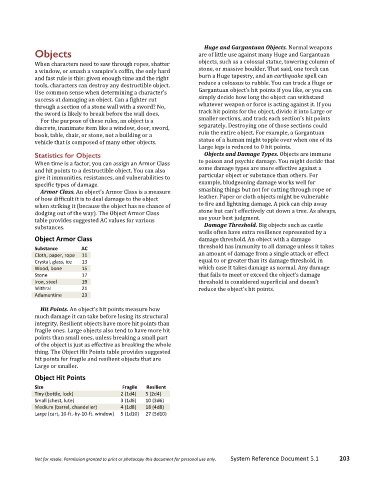
             Object	   Armor	   Class	                             damage	   threshold.	   An	   object	   with	   a	   damage
             Substance	     AC	                                    threshold	   has	   immunity	   to	   all	   damage	   unless	   it	   takes
             Cloth,	   paper,	   rope	     11	                     an	   amount	   of	   damage	   from	   a	   single	   attack	   or	   effect
             Crystal,	   glass,	   ice	     13	                    equal	   to	   or	   greater	   than	   its	   damage	   threshold,	   in
             Wood,	   bone	     15	                                which	   case	   it	   takes	   damage	   as	   normal.	   Any	   damage
             Stone	         17	                                    that	   fails	   to	   meet	   or	   exceed	   the	   object’s	   damage
             Iron,	   steel	     19	                               threshold	   is	   considered	   superficial	   and	   doesn’t
             Mithral	       21	                                    reduce	   the	   object’s	   hit	   points.
             Adamantine	     23

             	    Hit	   Points.	   An	   object’s	   hit	   points	   measure	   how
             much	   damage	   it	   can	   take	   before	   losing	   its	   structural
             integrity.	   Resilient	   objects	   have	   more	   hit	   points	   than
             fragile	   ones.	   Large	   objects	   also	   tend	   to	   have	   more	   hit
             points	   than	   small	   ones,	   unless	   breaking	   a	   small	   part
             of	   the	   object	   is	   just	   as	   effective	   as	   breaking	   the	   whole
             thing.	   The	   Object	   Hit	   Points	   table	   provides	   suggested
             hit	   points	   for	   fragile	   and	   resilient	   objects	   that	   are
             Large	   or	   smaller.
             Object	   Hit	   Points
             Size	                       Fragile	     Resilient
             Tiny	   (bottle,	   lock)	     2	   (1d4)	     5	   (2d4)
             Small	   (chest,	   lute)	     3	   (1d6)	     10	   (3d6)
             Medium	   (barrel,	   chandelier)	     4	   (1d8)	     18	   (4d8)
             Large	   (cart,	   10-  ft.-  by-  10-  ft.	   window)	    5	   (1d10)	    27	   (5d10)


Not for resale. Permission granted to print or photocopy this document for personal use only. System Reference Document 5.1 203 

