


Page 16 - Bi-National Socioeconomic Handbook 2020 Laredos Region
P. 16
HISTORY


        of “Laredos Region”


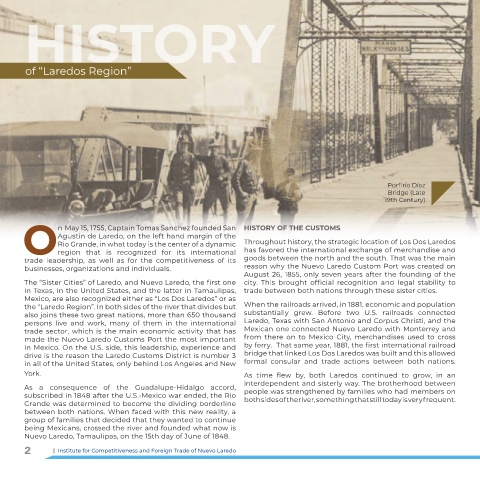
                                                                                                                   Porfirio Díaz
                                                                                                                    Bridge (Late
                                                                                                                   19th Century)


                  n  May 15, 1755, Captain Tomas Sanchez founded San  HISTORY OF THE CUSTOMS
                  Agustin de Laredo, on the left hand margin of the
                  Rio Grande, in what today is the center of a dynamic   Throughout history, the strategic location of Los Dos Laredos
        Oregion that is recognized for its international                 has favored the international exchange of merchandise and
        trade leadership, as well as for the competitiveness of its      goods between the north and the south. That was the main
        businesses, organizations and individuals.                       reason why the Nuevo Laredo Custom Port was created on
                                                                         August 26, 1855, only seven years after the founding of the
        The “Sister Cities” of Laredo, and Nuevo Laredo, the first one  city. This brought official recognition and legal stability to
        in Texas, in the United States, and the latter in Tamaulipas,  trade between both nations through these sister cities.
        Mexico, are also recognized either as “Los Dos Laredos” or as
        the “Laredo Region”. In both sides of the river that divides but   When the railroads arrived, in 1881, economic and population
        also joins these two great nations, more than 650 thousand       substantially  grew.  Before  two  U.S.  railroads  connected
        persons live and work, many of them in the international         Laredo, Texas with San Antonio and Corpus Christi, and the
        trade sector, which is the main economic activity that has       Mexican one connected Nuevo Laredo with Monterrey and
        made the Nuevo Laredo Customs Port the most important            from there on to Mexico City, merchandises used to cross
        in Mexico. On the U.S. side, this leadership, experience and     by ferry.  That same year, 1881, the first international railroad
        drive is the reason the Laredo Customs District is number 3      bridge that linked Los Dos Laredos was built and this allowed
        in all of the United States, only behind Los Angeles and New     formal consular and trade actions between both nations.
        York.                                                            As time flew by, both Laredos continued to grow, in an
                                                                         interdependent and sisterly way. The brotherhood between
        As a  consequence  of the Guadalupe-Hidalgo  accord,             people was strengthened by families who had members on
        subscribed in 1848 after the U.S.-Mexico war ended, the Rio      both sides of the river, something that still today is very frequent.
        Grande was determined to become the dividing borderline
        between both nations. When faced with this new reality, a
        group of families that decided that they wanted to continue
        being Mexicans, crossed the river and founded what now is
        Nuevo Laredo, Tamaulipas, on the 15th day of June of 1848.
        2        |  Institute for Competitiveness and Foreign Trade of Nuevo Laredo

