


Page 26 - FMT April
P. 26
Processing


          production of AHLs signal molecules
          and their receptor proteins. The
          LuxI/LuxR two-component system

          of V.  fischeri is considered as the
          model system for Gram-negative
          bacterial QS and played important
          role in luminescence phenomenon
          (Zhang et al., 2019) (Figure 2b).

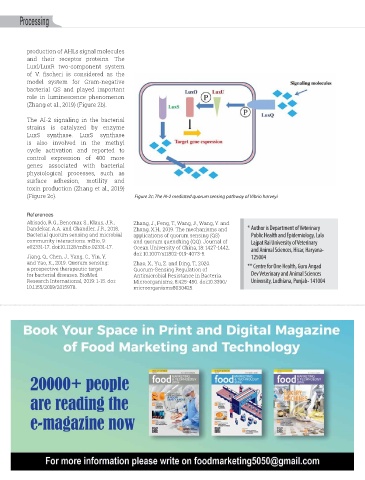
          The AI-2 signaling in the bacterial
          strains is catalyzed by enzyme
          LuxS synthase. LuxS synthase
          is also involved in the methyl
          cycle activation and reported to
          control expression of 400 more
          genes associated with bacterial
          physiological processes, such as
          surface adhesion, motility and
          toxin production (Zhang et al., 2019)
          (Figure 2c).                      Figure 2c: The AI-2 mediated quorum sensing pathway of Vibrio harveyi


          References
          Abisado, R.G., Benomar, S., Klaus, J.R.,   Zhang, J., Feng, T., Wang, J., Wang, Y. and
          Dandekar, A.A. and Chandler, J.R., 2018.   Zhang, X.H., 2019. The mechanisms and   *  Author is Department of Veterinary
          Bacterial quorum sensing and microbial   applications of quorum sensing (QS)   Public Health and Epidemiology, Lala
          community interactions. mBio, 9:   and quorum quenching (QQ). Journal of   Lajpat Rai University of Veterinary
          e02331-17. doi:10.1128/mBio.02331-17.  Ocean University of China, 18: 1427-1442.
                                           doi: 10.1007/s11802-019-4073-5.      and Animal Sciences, Hisar, Haryana-
          Jiang, Q., Chen, J., Yang, C., Yin, Y.                                125004
          and Yao, K., 2019. Quorum sensing:   Zhao, X., Yu, Z. and Ding, T., 2020.
          a prospective therapeutic target   Quorum-Sensing Regulation of      ** Centre for One Health, Guru Angad
          for bacterial diseases. BioMed   Antimicrobial Resistance in Bacteria.   Dev Veterinary and Animal Sciences
          Research International, 2019: 1-15. doi:   Microorganisms, 8:425-450. doi:10.3390/  University, Ludhiana, Punjab- 141004
          10.1155/2019/2015978.            microorganisms8030425.

