


Page 29 - FMT April
P. 29
www.fmtmagazine.in


          the relationship had a signifi cantly
          strong foundation. But it was
          Cama’s experience with the global
          automation supplier’s independent
          cart technology (ICT) that helped
          seal the deal… and provided the all-
          important physical link into the rest
          of the line.

          “Cama was one of the fi rst companies
          to deploy the iTRAK ICT in a customer
          application,” Panzeri  explains,  “so
          we  already  had  a  good  grounding
          in its operation and how it could be
          leveraged to deliver the additional
          flexibility many end users require.
          Using iTRAK, with its near limitless
          motion  profi les,  the  individual
          product carriers within our machine,
          controlled by the central PLC, are   greater accuracy and axis synergy   This, as it turns out, was made
          pitched automatically based on   compared to a more traditional    possible using another of Rockwell
          the width of the product or product   pneumatic systems, this approach   Automation’s  ICT  technologies,
          groups that require insertion into   also reduces mechanical stresses.  MagneMotion Lite.”
          the cartons. Thanks to this, the
          cartoner can work intermittently   “Advanced in-machine automation   Preceding the CL 175 cartoning
          or continuously depending on the   is second nature to us, thanks to our   machine, the Calvary Robotics line
          product and throughput required.  broad experience using robotics and   comprises three assembly machines,
                                           linear/ rotary servo technologies,”   a product- printing module and
          “The CL 175 comprises three main   Panzeri adds. “But a vital element   two testing stations, arranged in a
          operating stations,” he elaborates.   of this installation was the way in   ‘U’  shape.  All of the assembly and

          “In the first, carton boxes are picked   which the CL 175 integrates with the   testing steps are interlinked using
          from  a magazine and opened out     downstream assembly processes,   the MagneMotion ICT, so the best
          as  they  are placed into pockets on   so as not to cause any bottlenecks.   possible solution would see the
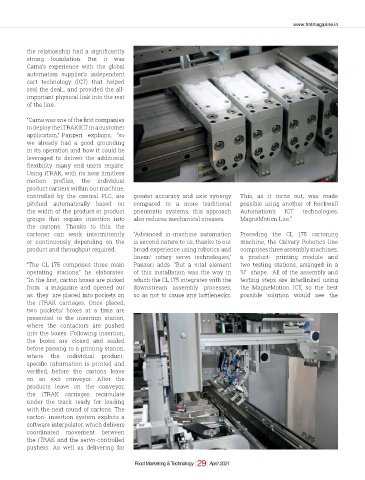
          the iTRAK carriages. Once placed,
          two pockets/ boxes at a time are
          presented to the insertion station,
          where the contactors are pushed
          into the boxes. Following insertion,
          the boxes are closed and sealed
          before passing to a printing station,
          where  the  individual  product-

          specific information is printed and

          verified, before the cartons leave
          on an exit conveyor. After the
          products leave on the conveyor,
          the iTRAK carriages recirculate
          under the track ready for loading
          with the next round of cartons. The
          carton- insertion system exploits a
          software interpolator, which delivers
          coordinated movement between
          the iTRAK and the servo-controlled
          pushers. As well as delivering far


                                           Food Marketing & Technology   29 April 2021

