


Page 176 - Year 3 SOW (2020)
P. 176
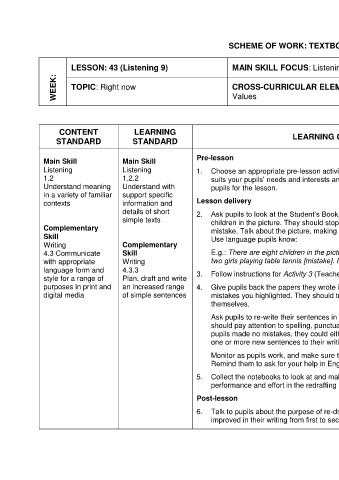
Primary Year 3 SK Scheme of Work
                                                          SCHEME OF WORK: TEXTBOOK BASED LESSON (Unit 3)


                   LESSON: 43 (Listening 9)                MAIN SKILL FOCUS: Listening                  THEME: World of Self, Family and Friends
               WEEK:    TOPIC: Right now                   CROSS-CURRICULAR ELEMENT: Language;          LANGUAGE/GRAMMAR FOCUS: Present continuous +

                                                           Values
                                                                                                        negative statements


                CONTENT           LEARNING                                                                              MATERIALS /       DIFFERENTIATION
               STANDARD           STANDARD                                LEARNING OUTLINE                             REFERENCES            STRATEGIES
                                                  Pre-lesson
            Main Skill         Main Skill                                                                              Get Smart plus 3   Differentiate learning
            Listening          Listening          1.  Choose an appropriate pre-lesson activity from the list in the introduction that   Student’s Book,   according to the needs of
            1.2                1.2.2                 suits your pupils’ needs and interests and that will review language and prepare   p.29   your pupils and class. Please
            Understand meaning   Understand with     pupils for the lesson.                                                            see the seven differentiation
            in a variety of familiar   support specific                                                                Teacher’s Book,   strategies listed in the
            contexts           information and    Lesson delivery                                                      p.51            introduction. Please also
                               details of short   2.  Ask pupils to look at the Student’s Book, p.29. Tell pupils you will talk about the      consider the following:
                               simple texts          children in the picture. They should stop you when they hear you make a           Choose the example(s) you
            Complementary                            mistake. Talk about the picture, making some mistakes in relation to content.     model on the board so that
            Skill                                    Use language pupils know:                                                         you are supporting the pupils
            Writing            Complementary                                                                                           who most need it. This will
            4.3 Communicate    Skill                 E.g.: There are eight children in the picture. They are all doing sports. I can see   help them work more
            with appropriate   Writing               two girls playing table tennis [mistake]. I think they are having fun. Etc…       independently and get a
            language form and   4.3.3             3.  Follow instructions for Activity 3 (Teacher’s Book, p.51).                       greater sense of
            style for a range of   Plan, draft and write                                                                               achievement.
            purposes in print and   an increased range   4.  Give pupils back the papers they wrote in Lesson 41. Ask pupils to look at the
            digital media      of simple sentences   mistakes you highlighted. They should try to correct their sentences by           Have more proficient pupils
                                                     themselves.                                                                       work with you to help less
                                                                                                                                       proficient pupils in the class
                                                     Ask pupils to re-write their sentences in their notebooks. Remind them that they   with their redrafting.
                                                     should pay attention to spelling, punctuation and neatness in this final version. If
                                                     pupils made no mistakes, they could either focus on neatness or they could add    Fast finishers can write more
                                                     one or more new sentences to their writing.                                       sentences or write about
                                                                                                                                       another person.
                                                     Monitor as pupils work, and make sure they understand their own corrections.
                                                     Remind them to ask for your help in English.
                                                  5.  Collect the notebooks to look at and make a note yourself of pupils’
                                                     performance and effort in the redrafting process.
                                                  Post-lesson
                                                  6.  Talk to pupils about the purpose of re-drafting their work. Ask them what they
                                                     improved in their writing from first to second draft.


                                                                                                                                                         89

