


Page 260 - Year 3 SOW (2020)
P. 260
Primary Year 3 SK Scheme of Work
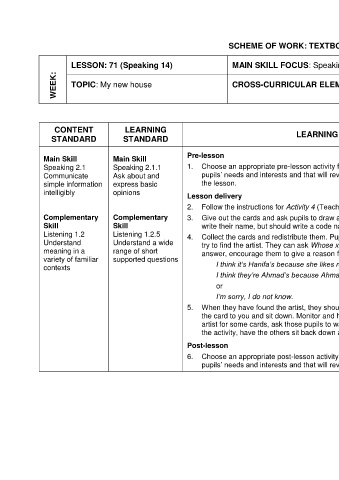
                                                          SCHEME OF WORK: TEXTBOOK BASED LESSON (Unit 5)

                   LESSON: 71 (Speaking 14)                MAIN SKILL FOCUS: Speaking                   THEME: World of self, family and friends
               WEEK:    TOPIC: My new house                CROSS-CURRICULAR ELEMENT: Language           LANGUAGE/GRAMMAR FOCUS: Questions with


                                                                                                        possessive pronoun: Whose?


               CONTENT          LEARNING                                                                                    MATERIALS /     DIFFERENTIATION
              STANDARD          STANDARD                                   LEARNING OUTLINE                                 REFERENCES        STRATEGIES

            Main Skill       Main Skill         Pre-lesson                                                                  Get Smart plus 3   Differentiate learning
            Speaking 2.1     Speaking 2.1.1               1.  Choose an appropriate pre-lesson activity from the list in the introduction that suits your   Student’s Book,   according to the
            Communicate      Ask about and         pupils’ needs and interests and that will review clothes vocabulary to prepare pupils for   p.47   needs of your pupils
            simple information   express basic     the lesson.                                                                              and class. Please see
            intelligibly     opinions           Lesson delivery                                                             Teacher’s Book,   the seven
                                                                                                                            p.77            differentiation
                                                2.  Follow the instructions for Activity 4 (Teacher’s Book, p.77).          Small pieces of   strategies listed in the
            Complementary    Complementary      3.  Give out the cards and ask pupils to draw a piece of clothing on them. They shouldn’t   paper/card, one   introduction. Please
            Skill            Skill                 write their name, but should write a code name.                          per pupil       also consider the
            Listening 1.2    Listening 1.2.5    4.  Collect the cards and redistribute them. Pupils should mingle around the classroom to   following:
            Understand       Understand a wide     try to find the artist. They can ask Whose xxx? or Is this yours/hers? etc. When pupils      If giving a reason is
            meaning in a     range of short        answer, encourage them to give a reason for their answer, for example:                   too challenging for
            variety of familiar   supported questions                                                                                       some/all of your
            contexts                                   I think it’s Hanifa’s because she likes red shoes.                                   pupils, then they can
                                                       I think they’re Ahmad’s because Ahmad is good at drawing.                            say I think… to give
                                                       or                                                                                   their opinions.
                                                       I’m sorry, I do not know.
                                                5.  When they have found the artist, they should write that pupil’s name on the card, return
                                                   the card to you and sit down. Monitor and help pupils. If there are difficulties finding the
                                                   artist for some cards, ask those pupils to wait at the front of the classroom. At the end of
                                                   the activity, have the others sit back down and these pupils can ask the whole class.
                                                Post-lesson
                                                6.  Choose an appropriate post-lesson activity from the list in the introduction that suits your
                                                   pupils’ needs and interests and that will review the main areas covered in the lesson.


                                                                                                                                                        132

