


Page 262 - Year 3 SOW (2020)
P. 262
Primary Year 3 SK Scheme of Work
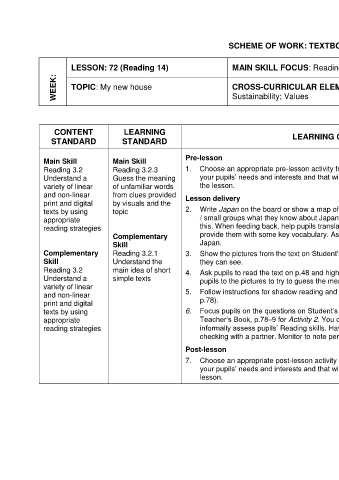
                                                          SCHEME OF WORK: TEXTBOOK BASED LESSON (Unit 5)


                   LESSON: 72 (Reading 14)                 MAIN SKILL FOCUS: Reading                    THEME: World of Self, Family & Friends
               WEEK:    TOPIC: My new house                CROSS-CURRICULAR ELEMENT: Global             LANGUAGE/GRAMMAR FOCUS: Present tense There

                                                           Sustainability; Values
                                                                                                        is/are: Singular & plural; Prepositions of place


              CONTENT           LEARNING                                                                                   MATERIALS /     DIFFERENTIATION
              STANDARD         STANDARD                                   LEARNING OUTLINE                                REFERENCES          STRATEGIES
                                               Pre-lesson
            Main Skill       Main Skill                                                                                   Get Smart plus 3   Differentiate learning
            Reading 3.2      Reading 3.2.3            1.  Choose an appropriate pre-lesson activity from the list in the introduction that suits   Student’s Book,   according to the needs of
            Understand a     Guess the meaning     your pupils’ needs and interests and that will review key language to prepare pupils for   p.48–49   your pupils and class.
            variety of linear   of unfamiliar words   the lesson.                                                                         Please see the seven
            and non-linear   from clues provided   Lesson delivery                                                        Teacher’s Book,   differentiation strategies
            print and digital   by visuals and the                                                                        p.78–79         listed in the introduction.
            texts by using   topic             2.  Write Japan on the board or show a map of Japan. Ask pupils to tell each other in pairs   Map of Japan   Please also consider the
            appropriate                            / small groups what they know about Japan. They will probably use first language for   (optional)   following:
            reading strategies                     this. When feeding back, help pupils translate some of their ideas into English and/or   There may be some first
                             Complementary         provide them with some key vocabulary. Ask them what they know about houses in   Cut up pictures   language used in this
                             Skill                 Japan.                                                                 from Student’s   lesson. You can
            Complementary    Reading 3.2.1     3.  Show the pictures from the text on Student’s Book, p.48. Ask pupils to tell you what   Book, p.48   encourage and support
            Skill            Understand the        they can see.                                                                          different pupils to use as
            Reading 3.2      main idea of short   4.  Ask pupils to read the text on p.48 and highlight or underline any new words. Direct   much English as they can
            Understand a     simple texts          pupils to the pictures to try to guess the meaning of the new words.                   by helping them with
            variety of linear                                                                                                             vocabulary and language
            and non-linear                     5.  Follow instructions for shadow reading and questions for Activity 1 (Teacher’s Book,   that you think each pupil
            print and digital                      p.78).                                                                                 is capable of.
            texts by using                     6.  Focus pupils on the questions on Student’s Book p.49 and follow the instructions in
            appropriate                            Teacher’s Book, p.78–9 for Activity 2. You could use Activity 2 as an opportunity to
            reading strategies                     informally assess pupils’ Reading skills. Have pupils do this alone initially before
                                                   checking with a partner. Monitor to note performance of individual pupils.
                                               Post-lesson
                                               7.  Choose an appropriate post-lesson activity from the list in the introduction that suits
                                                   your pupils’ needs and interests and that will review the main areas covered in the
                                                   lesson.


                                                                                                                                                        133

