


Page 348 - Year 3 SOW (2020)
P. 348
Primary Year 3 SK Scheme of Work
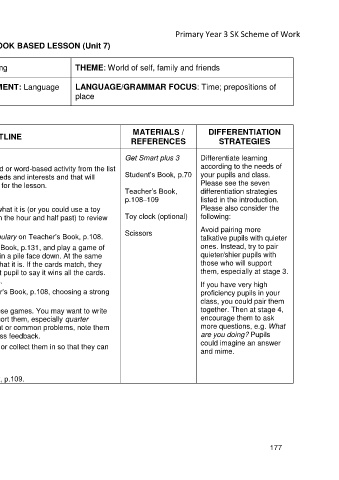
 SCHEME OF WORK: TEXTBOOK BASED LESSON (Unit 7)


 LESSON: 108 (Speaking 21)   MAIN SKILL FOCUS: Speaking   THEME: World of self, family and friends
 WEEK:    TOPIC: Out and about   CROSS-CURRICULAR ELEMENT: Language    LANGUAGE/GRAMMAR FOCUS: Time; prepositions of

                    place


 CONTENT   LEARNING               MATERIALS /        DIFFERENTIATION
 STANDARD   STANDARD   LEARNING OUTLINE   REFERENCES   STRATEGIES
       Pre-lesson
 Main Skill   Main Skill        Get Smart plus 3   Differentiate learning
 Speaking 2.1   Speaking 2.1.2   1.  Choose an appropriate pre-lesson flashcard or word-based activity from the list      according to the needs of
 Communicate   Find out about and   in the introduction that suits your pupils’ needs and interests and that will   Student’s Book, p.70  your pupils and class.
 simple information   describe everyday   review places vocabulary to prepare pupils for the lesson.      Please see the seven
 intelligibly   routines   Lesson delivery    Teacher’s Book,   differentiation strategies
                                p.108–109          listed in the introduction.
       2.  Draw a clock on the board and ask pupils what it is (or you could use a toy      Please also consider the
 Complementary   Complementary   clock). Draw various times on the board (on the hour and half past) to review   Toy clock (optional)   following:
 Skill   Skill   time taught so far.               Avoid pairing more
 Listening 1.2   Listening 1.2.5   3.  Follow instructions for Warm up and Vocabulary on Teacher’s Book, p.108.   Scissors   talkative pupils with quieter
 Understand   Understand a wide   4.  Have pupils cut out the cards on Student’s Book, p.131, and play a game of   ones. Instead, try to pair
 meaning in a   range of short   Snap in pairs – pupils each put their cards in a pile face down. At the same   quieter/shier pupils with
 variety of familiar   supported questions   time, they turn over the top card and say what it is. If the cards match, they   those who will support
 contexts   also have to say Snap (or ‘Same’). The first pupil to say it wins all the cards.   them, especially at stage 3.
    Continue until one pupil has no more cards.    If you have very high
 5.  Follow instructions for Activity 1 on Teacher’s Book, p.108, choosing a strong   proficiency pupils in your
 pair to model the activity for the class.         class, you could pair them
 Monitor and support pupils as they play these games. You may want to write   together. Then at stage 4,
 some of the language on the board to support them, especially quarter   encourage them to ask
 past…and quarter to.. If there are persistent or common problems, note them   more questions, e.g. What
 down and return to them later for whole class feedback.   are you doing? Pupils
                                                   could imagine an answer
 Make sure that pupils keep the cards safe, or collect them in so that they can   and mime.
 be used in later lessons.
 Post-lesson
 6.  Play the Optional game on Teacher’s Book, p.109.


                                                                    177

