


Page 54 - Year 3 SOW (2020)
P. 54
Primary Year 3 SK Scheme of Work
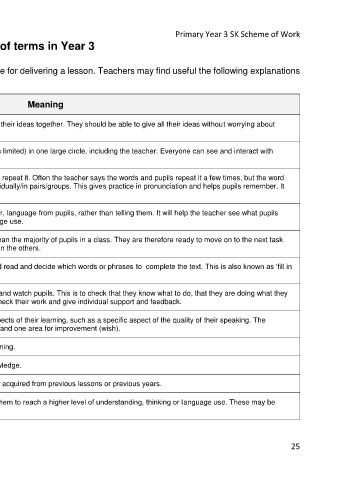
 5.  Glossary of terms in Year 3

 Each lesson in the Scheme of Work includes a Learning Outline with guidance for delivering a lesson. Teachers may find useful the following explanations
 of important terms used in Learning Outlines.

 Term in Year 3
 Scheme of Work   Meaning

 brainstorm    This is when pupils work with one or more other pupils to put all their ideas together. They should be able to give all their ideas without worrying about
 accuracy. It may be listing, categorising etc.

 circle game   In this kind of whole-class activity, pupils sit (or stand, if space is limited) in one large circle, including the teacher. Everyone can see and interact with
 everyone else.

 drill   Drilling is where the pupils hear a word, phrase or sentence and repeat it. Often the teacher says the words and pupils repeat it a few times, but the word
 may be recorded and pupils may repeat more/fewer times, individually/in pairs/groups. This gives practice in pronunciation and helps pupils remember. It
 can be done in different fun ways.
 elicit   This technique is where the teacher gets the information, answer, language from pupils, rather than telling them. It will help the teacher see what pupils
 know and makes pupils more active in their learning and language use.
 fast finishers   Pupils who are able to work at a faster pace on a specific task than the majority of pupils in a class. They are therefore ready to move on to the next task
 sooner than the majority of pupils because they finish earlier than the others.

 gapped text   This is a text which has missing words or phrases. Pupils should read and decide which words or phrases to  complete the text. This is also known as ‘fill in
 the blanks’ activity.

 monitor   Teachers monitor when they walk around the classroom to see and watch pupils. This is to check that they know what to do, that they are doing what they
 should be doing, to answer any questions and, importantly, to check their work and give individual support and feedback.

 peer-assessment   This is when pupils give feedback to other pupils on specific aspects of their learning, such as a specific aspect of the quality of their speaking. The
 feedback can take the form of two things that were good (stars) and one area for improvement (wish).

 post-lesson   Activity at the end of a lesson to review and consolidate the learning.

 pre-lesson   Activity at the beginning of a lesson to activate pupils’ prior knowledge.

 prior knowledge   Knowledge and skills which pupils already have. Pupils possibly acquired from previous lessons or previous years.

 scaffolding   Teaching strategies that aim to support pupils’ learning to help them to reach a higher level of understanding, thinking or language use. These may be
 asking questions, giving examples or using pictures.


                                                                         25

