


Page 59 - Year 3 SOW (2020)
P. 59
Primary Year 3 SK Scheme of Work
                        Term in Year 3 Curriculum
                              Framework                                                                   Meaning
                                                                                   Reading
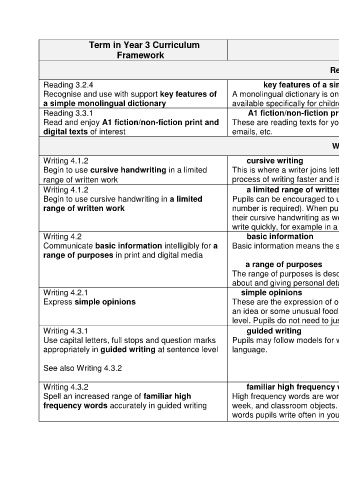
            Reading 3.2.4                                                key features of a simple monolingual dictionary
            Recognise and use with support key features of   A monolingual dictionary is one which has only English (the words and the definitions). Various titles are
            a simple monolingual dictionary                available specifically for children learning English or for CEFR A1 level learners.
            Reading 3.3.1                                         A1 fiction/non-fiction print and digital texts
            Read and enjoy A1 fiction/non-fiction print and   These are reading texts for young learners of English at CEFR A1 level. Examples include stories, quizzes,
            digital texts of interest                      emails, etc.
                                                                                    Writing
            Writing 4.1.2                                     cursive writing
            Begin to use cursive handwriting in a limited   This is where a writer joins letters together in a word (also known as joined-up writing or longhand). It makes the
            range of written work                          process of writing faster and is used by native writers of alphabetic scripts.
            Writing 4.1.2                                     a limited range of written work
            Begin to use cursive handwriting in a limited   Pupils can be encouraged to use cursive writing where it is appropriate (i.e. where more than just a letter or
            range of written work                          number is required). When pupils work on drafts of their writing, the teacher should encouraged them to work on
                                                           their cursive handwriting as well as on their language in a final version in particular. However, if pupils are to
                                                           write quickly, for example in a Listening task or a brainstorming activity, then they needn’t use cursive writing.
            Writing 4.2                                       basic information
            Communicate basic information intelligibly for a   Basic information means the same as simple information (see Speaking 2.1 above).
            range of purposes in print and digital media
                                                                 a range of purposes
                                                           The range of purposes is described in the Learning Standards for Years 1-6. These purposes involve finding out
                                                           about and giving personal details and opinions.
            Writing 4.2.1                                      simple opinions
            Express simple opinions                        These are the expression of opinions such as what pupils like, dislike, prefer, or what they think of, for example,
                                                           an idea or some unusual food or clothes. The language used here will be very simple and the opinions at a basic
                                                           level. Pupils do not need to justify their opinion, but could begin to be asked for this in a basic way.
            Writing 4.3.1                                     guided writing
            Use capital letters, full stops and question marks   Pupils may follow models for writing, or the teacher will give other support with content, vocabulary and
            appropriately in guided writing at sentence level    language.

            See also Writing 4.3.2

            Writing 4.3.2                                     familiar high frequency words
            Spell an increased range of familiar high      High frequency words are words which pupils use often in Year 3 writing, such as colours, numbers, days of the
            frequency words accurately in guided writing   week, and classroom objects. Please use your own judgement on familiar high frequency words, according to
                                                           words pupils write often in your lessons.

                                                                                                                                                              28

