


Page 57 - Year 3 SOW (2020)
P. 57
Primary Year 3 SK Scheme of Work
Term in Year 3 Curriculum
Framework Meaning
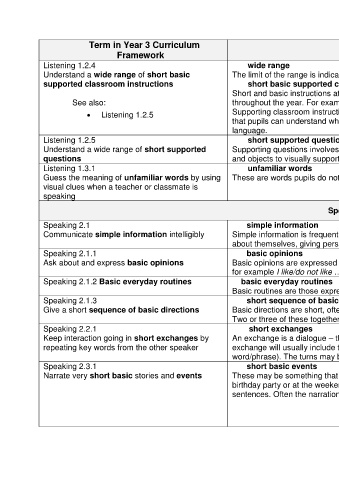
Listening 1.2.4 wide range
Understand a wide range of short basic The limit of the range is indicated in the schemes of work, where suggestions are made for classroom language.
supported classroom instructions short basic supported classroom instructions
Short and basic instructions at the Year 3 pupil age should contain a few clear words, and are repeated
See also: throughout the year. For example, Stand up in a circle.
Listening 1.2.5 Supporting classroom instructions involves, for example, using mime, demonstration, modelling and routines so
that pupils can understand what the teacher would like them to do, without the teacher having to use first
language.
Listening 1.2.5 short supported questions
Understand a wide range of short supported Supporting questions involves using mime and gesture, modelling and routines. This also includes using pictures
questions and objects to visually support meaning.
Listening 1.3.1 unfamiliar words
Guess the meaning of unfamiliar words by using These are words pupils do not already understand or produce in English.
visual clues when a teacher or classmate is
speaking
Speaking
Speaking 2.1 simple information
Communicate simple information intelligibly Simple information is frequent, everyday information which is simple cognitively. Examples include pupils talking
about themselves, giving personal information or saying what they like.
Speaking 2.1.1 basic opinions
Ask about and express basic opinions Basic opinions are expressed in simple language and are simple in both the meaning and the thinking behind it,
for example I like/do not like … or giving an opinion about a film (e.g. It was good.)
Speaking 2.1.2 Basic everyday routines basic everyday routines
Basic routines are those expressed in simple language, which are very relevant to pupils’ lives.
Speaking 2.1.3 short sequence of basic directions
Give a short sequence of basic directions Basic directions are short, often two or three words long and use imperative verb forms, for example ‘Turn left’.
Two or three of these together make a short sequence of basic directions.
Speaking 2.2.1 short exchanges
Keep interaction going in short exchanges by An exchange is a dialogue – that is, when there are two people communicating (or more than two). A short
repeating key words from the other speaker exchange will usually include two turns but could include up to three or four turns if they are very short (e.g. one
word/phrase). The turns may be just one word or phrase, a fixed expression, or may be short simple sentences.
Speaking 2.3.1 short basic events
Narrate very short basic stories and events These may be something that a pupil has experienced, such as something that happened during holidays, a
birthday party or at the weekend. They are personal and will be very short, for example up to three or four
sentences. Often the narration will be prepared in advance if it is this long. It will be in very simple language.
27

