


Page 254 - Year 1 SOW 2020
P. 254
CROSS -
 CONTENT   LEARNING    MATERIALS /        DIFFERENTIATION      TEACHER’S NOTES /
 STANDARD   STANDARD   LEARNING OUTLINE   REFERENCES   CURRICULAR   STRATEGIES   REMARKS
                        ELEMENT

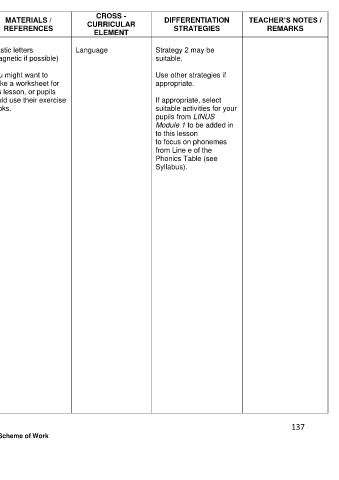
 MAIN SKILL   MAIN SKILL   Pre-lesson   Plastic letters   Language    Strategy 2 may be
       Task 4   (magnetic if possible)   suitable.
 Reading    Reading
 3.1   3.1.3   Lesson delivery   You might want to   Use other strategies if
 Recognise words in   Blend phonemes (CVC,   1. Review letters of the alphabet using   make a worksheet for   appropriate.
 linear and non-linear   CCVC)   plastic letters by playing a game where   this lesson, or pupils
 texts by using      you point to a letter, pupils tell you what   could use their exercise   If appropriate, select
 knowledge of sounds of      letter it is. Then ask them to tell you a   books.   suitable activities for your
 letters      word beginning with that letter (prepare   pupils from LINUS
       this in advance so you use letters for   Module 1 to be added in
       words the pupils know well and can   to this lesson
       guess easily). Do this three times. Put the   to focus on phonemes
 COMPLEMENTARY   COMPLEMENTARY   letters on the board if you can.   from Line e of the
 SKILL   SKILL                          Phonics Table (see
       2. Play ‘I spy’ – Teacher thinks of a word   Syllabus).
 Reading    Reading    for something in the classroom they can
 3.1   3.1.4   see and says ‘I spy with my little eye,
 Recognise words in   Segment phonemes   something beginning with A’ (for
 linear and non-linear   (CVC, CCVC)   example). Pupils guess the word the
 texts by using   teacher is thinking of. The pupil who
 knowledge of sounds of   guesses correctly becomes teacher.
 letters   Pupils may need support with this so they
    match phonemes and letter names.

 3. Using the magnetic letters on the
 board, present an anagram (a word with
 letters mixed up). The word should
 review toy vocabulary (e.g. o – y – t).
 Pupils guess the word and spelling.

 4. Give pupils more anagrams to solve in
 pairs. You could use the board or give
 them a worksheet.

 5. Ask pupils to create their own
 anagrams. They may need extra support
 in this as the letters need to be right.

 6. Pairs swap anagrams and solve each
 other’s’ anagrams.

 Post lesson
 Task 11 (toys that they have at home)


                                                                         137
 Primary Year 1 Scheme of Work

