


Page 122 - Class-11-Physics-Part-1_Neat
P. 122
108                                                                                    PHYSICS

                                      In simple terms, the law can be stated thus :
                                      Forces in nature always occur between pairs of bodies.  Force on a body A by body
                                      B is equal and opposite to the force on the body B by A.
                                      Action and reaction forces are simultaneous forces.  There is no cause-effect
                                      relation between action and reaction.  Any of the two mutual forces can be
                                      called action and the other reaction.  Action and reaction act on different
                                      bodies and so they cannot be cancelled out.  The internal action and reaction
                                      forces between different parts of a body do, however, sum to zero.
                                   7.  Law of Conservation of Momentum
                                      The total momentum of an isolated system of particles is conserved.  The law
                                      follows from the second and third law of motion.
                                   8.  Friction
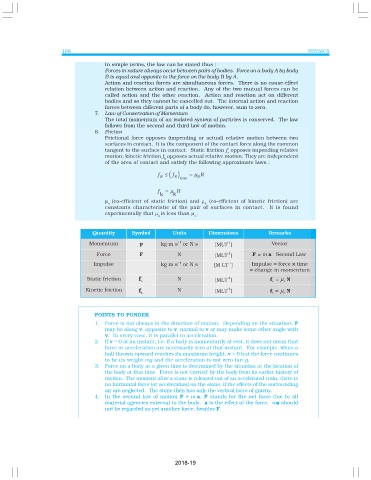
                                      Frictional force opposes (impending or actual) relative motion between two
                                      surfaces in contact.  It is the component of the contact force along the common
                                      tangent to the surface in contact.  Static friction f  opposes impending relative
                                                                                  s
                                      motion; kinetic friction f  opposes actual relative motion. They are independent
                                                           k
                                      of the area of contact and satisfy the following approximate laws :
                                                         f s  ≤  ( )  = µ s R
                                                              f
                                                               s
                                                                 max
                                                         f  = µ  R
                                                          k   k
                                      µ  (co-efficient of static friction) and µ  (co-efficient of kinetic friction) are
                                       s                                  k
                                      constants characteristic of the pair of surfaces in contact.  It is found
                                      experimentally that µ is less than µ .
                                                         k            s


                                   POINTS TO PONDER
                                   1.  Force is not always in the direction of motion.  Depending on the situation, F
                                      may be along v, opposite to v, normal to v or may make some other angle with
                                      v.  In every case, it is parallel to acceleration.
                                   2.  If v = 0 at an instant, i.e. if a body is momentarily at rest, it does not mean that
                                      force or acceleration are necessarily zero at that instant.  For example, when a
                                      ball thrown upward reaches its maximum height, v = 0 but the force continues
                                      to be its weight mg and the acceleration is not zero but g.
                                   3.  Force on a body at a given time is determined by the situation at the location of
                                      the body at that time.  Force is not ‘carried’ by the body from its earlier history of
                                      motion.  The moment after a stone is released out of an accelerated train, there is
                                      no horizontal force (or acceleration) on the stone, if the effects of the surrounding
                                      air are neglected.  The stone then has only the vertical force of gravity.
                                   4.  In the second law of motion F  = m  a, F  stands for the net force due to all
                                      material agencies external to the body.  a is the effect of the force.  ma should
                                      not be regarded as yet another force, besides F.


                                                               2018-19

