


Page 125 - Class-11-Physics-Part-1_Neat
P. 125
LAWS OF MOTION                                                                             111

                       5.16 Two masses 8 kg and 12 kg are connected at the two ends of a light  inextensible
                             string that goes over a frictionless pulley.  Find the acceleration of the masses, and
                             the tension in the string when the masses are released.
                       5.17 A nucleus is at rest in the laboratory frame of reference.  Show that if it disintegrates
                             into two smaller nuclei the products must move in opposite directions.
                       5.18 Two billiard balls each of mass 0.05 kg moving in opposite directions with speed 6 m s -1
                             collide and rebound with the same speed.  What is the impulse imparted to each ball due
                             to the other ?
                       5.19 A shell of mass 0.020 kg is fired by a gun of mass 100 kg.  If the muzzle  speed of the
                                          -1
                             shell is 80 m s , what is the recoil speed of the gun ?
                       5.20 A batsman deflects a ball by an angle of 45° without changing its initial speed which is
                             equal to 54 km/h.  What is the impulse imparted to the ball ?  (Mass of the ball is 0.15 kg.)
                       5.21 A stone of mass 0.25 kg tied to the end of a string is whirled round in a circle of radius
                             1.5 m with a speed of 40 rev./min in a horizontal plane. What is the tension in  the
                             string ?  What is the maximum speed with which the stone can be whirled around if
                             the string can withstand a maximum tension of 200 N ?
                       5.22 If, in Exercise 5.21, the speed of the stone is increased beyond the maximum permissible
                             value, and the string breaks suddenly, which of the following correctly describes the
                             trajectory of the stone after the string breaks :
                             (a) the stone moves radially outwards,
                             (b) the  stone flies off tangentially from the instant the string breaks,
                             (c) the stone flies off at an angle with the tangent whose magnitude depends on the
                                speed of the particle ?
                       5.23 Explain why
                             (a) a horse cannot pull a cart and run in empty space,
                             (b) passengers are thrown forward from their seats when a speeding bus stops
                                  suddenly,
                             (c) it is easier to pull a lawn mower than to push it,
                             (d) a cricketer moves his hands backwards while holding a catch.
                       Additional Exercises
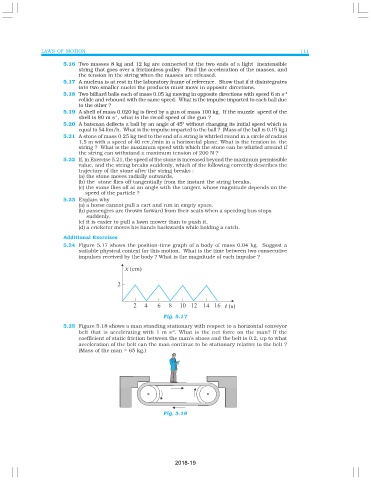
                       5.24 Figure 5.17 shows the position-time graph of a body of mass 0.04 kg.  Suggest a
                             suitable physical context for this motion.  What is the time between two consecutive
                             impulses received by the body ? What is the magnitude of each impulse ?


                                                           Fig. 5.17

                       5.25 Figure 5.18 shows a man standing stationary with respect to a horizontal conveyor
                             belt that is accelerating with 1 m  s . What is the net force on the man? If the
                                                              -2
                             coefficient of static friction between the man’s shoes and the belt is 0.2, up to what
                             acceleration of the belt can the man continue to be stationary relative to the belt ?
                             (Mass of the man = 65 kg.)


                                                           Fig. 5.18


                                                               2018-19

