


Page 215 - Class-11-Physics-Part-1_Neat
P. 215
GRAVITATION                                                                                201

                       8.2  Choose the correct alternative :
                            (a) Acceleration due to gravity increases/decreases with increasing altitude.
                            (b) Acceleration due to gravity increases/decreases with increasing depth (assume the
                               earth to be a sphere of uniform density).
                            (c) Acceleration due to gravity is independent of mass of the earth/mass of the body.
                            (d) The formula –G Mm(1/r 2   – 1/r 1 )   is more/less accurate than the formula
                               mg(r 2  – r 1 ) for the difference of potential energy between two points r 2  and r 1  distance
                               away from the centre of the earth.
                       8.3 Suppose there existed a planet that went around the sun twice as fast as the earth.
                            What would be its orbital size as compared to that of the earth ?
                       8.4 Io, one of the satellites of Jupiter, has an orbital period of 1.769 days and the radius
                            of the orbit is 4.22 × 10  m. Show that the mass of Jupiter is about one-thousandth
                                                 8
                            that of the sun.
                                                                        11
                       8.5  Let us assume that our galaxy consists of 2.5 × 10 stars each of one solar mass. How
                            long will a star at a distance of 50,000 ly from the galactic centre take to complete one
                                                                               5
                            revolution ? Take the diameter of the Milky Way to be 10  ly.
                       8.6 Choose the correct alternative:
                            (a) If the zero of potential energy is at infinity, the total energy of an orbiting satellite
                               is negative of its kinetic/potential energy.
                            (b) The energy required to launch an orbiting satellite out of earth’s gravitational
                               influence is more/less than the energy required to project a stationary object at
                               the same height (as the satellite) out of earth’s influence.
                       8.7  Does the escape speed of a body from the earth depend on (a) the mass of the body, (b)
                            the location from where it is projected, (c) the direction of projection, (d) the height of
                            the location from where the body is launched?
                       8.8 A comet orbits the sun in a highly elliptical orbit. Does the comet have a constant (a)
                            linear speed, (b) angular speed, (c) angular momentum, (d) kinetic energy, (e) potential
                            energy, (f) total energy throughout its orbit? Neglect any mass loss of the comet when
                            it comes very close to the Sun.
                       8.9  Which of the following symptoms is likely to afflict an astronaut in space (a) swollen
                            feet, (b) swollen face, (c) headache, (d) orientational problem.
                       8.10 In the following two exercises, choose the correct answer from among the given ones:
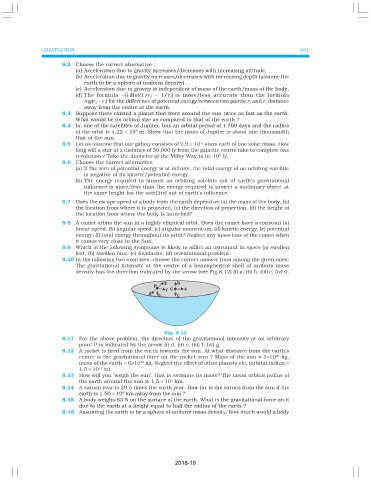
                            The gravitational intensity at the centre of a hemispherical shell of uniform mass
                            density has the direction indicated by the arrow (see Fig 8.12) (i) a, (ii) b, (iii) c, (iv) 0.


                                                           Fig. 8.12
                       8.11  For the above problem, the direction of the gravitational intensity at an arbitrary
                             point P is indicated by the arrow (i) d, (ii) e, (iii) f, (iv) g.
                       8.12  A rocket is fired from the earth towards the sun. At what distance from the earth’s
                             centre is the gravitational force on the rocket zero ? Mass of the sun = 2×10  kg,
                                                                                                   30
                             mass of the earth = 6×10  kg. Neglect the effect of other planets etc. (orbital radius =
                                                   24
                                    11
                             1.5 × 10  m).
                       8.13  How will you ‘weigh the sun’, that is estimate its mass? The mean orbital radius of
                             the earth around the sun is 1.5 × 10  km.
                                                              8
                       8.14  A saturn year is 29.5 times the earth year. How far is the saturn from the sun if the
                                            8
                             earth is 1.50 × 10  km away from the sun ?
                       8.15  A body weighs 63 N on the surface of the earth. What is the gravitational force on it
                             due to the earth at a height equal to half the radius of the earth ?
                       8.16 Assuming the earth to be a sphere of uniform mass density, how much would a body


                                                               2018-19

