


Page 210 - Class-11-Physics-Part-1_Neat
P. 210
196 PHYSICS
Considering gravitational potential energy at 8.11 GEOSTATIONARY AND POLAR
infinity to be zero, the potential energy at distance SATELLITES
(R +h) from the centre of the earth is
e An interesting phenomenon arises if in we
G m M arrange the value of (R + h) such that T in
. P E = − E (8.41) E
(R + h ) Eq. (8.37) becomes equal to 24 hours. If the
E
circular orbit is in the equatorial plane of the
The K.E is positive whereas the P.E is
negative. However, in magnitude the K.E. is half earth, such a satellite, having the same period
the P.E, so that the total E is as the period of rotation of the earth about its
own axis would appear stationery viewed from
G m M a point on earth. The (R + h) for this purpose
E = K .E + . P E = − E (8.42) E
2(R + h ) works out to be large as compared to R :
E
E
The total energy of an circularly orbiting T G M 1/ 3
2
satellite is thus negative, with the potential R + h = E
E 2 (8.43)
energy being negative but twice is magnitude of 4π
the positive kinetic energy. and for T = 24 hours, h works out to be 35800 km.
When the orbit of a satellite becomes which is much larger than R . Satellites in a
E
elliptic, both the K.E. and P.E. vary from point circular orbits around the earth in the
to point. The total energy which remains equatorial plane with T = 24 hours are called
constant is negative as in the circular orbit case. Geostationery Satellites. Clearly, since the earth
This is what we expect, since as we have rotates with the same period, the satellite would
discussed before if the total energy is positive or appear fixed from any point on earth. It takes
zero, the object escapes to infinity. Satellites very powerful rockets to throw up a satellite to
are always at finite distance from the earth and such large heights above the earth but this has
hence their energies cannot be positive or zero. been done in view of the several benefits of many
practical applications.
t Example 8.8 A 400 kg satellite is in a circular
orbit of radius 2R E about the Earth. How much
energy is required to transfer it to a circular
orbit of radius 4R E ? What are the changes in
the kinetic and potential energies ?
Answer Initially,
G M m
E
E = −
i
R 4 E
While finally
G M m
E
E = −
f
R 8 E
The change in the total energy is
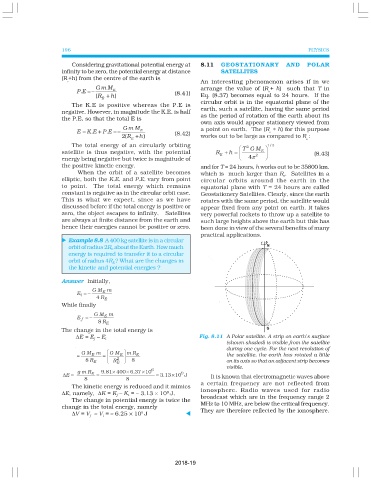
Fig. 8.11 A Polar satellite. A strip on earth’s surface
∆E = E f – E i
(shown shaded) is visible from the satellite
during one cycle. For the next revolution of
G M E m G M E m R E
= = the satellite, the earth has rotated a little
8 R E R 2 E 8 on its axis so that an adjacent strip becomes
visible.
6
g m R . 9 81 × 400 × . 6 37 × 10 9
∆E = E = = . 3 13 × 10 J It is known that electromagnetic waves above
8 8
a certain frequency are not reflected from
The kinetic energy is reduced and it mimics
9
∆E, namely, ∆K = K f – K i = – 3.13 × 10 J. ionosphere. Radio waves used for radio
The change in potential energy is twice the broadcast which are in the frequency range 2
change in the total energy, namely MHz to 10 MHz, are below the critical frequency.
9
∆V = V – V = – 6.25 × 10 J t They are therefore reflected by the ionosphere.
f
i
2018-19

