


Page 213 - Class-11-Physics-Part-1_Neat
P. 213
GRAVITATION 199
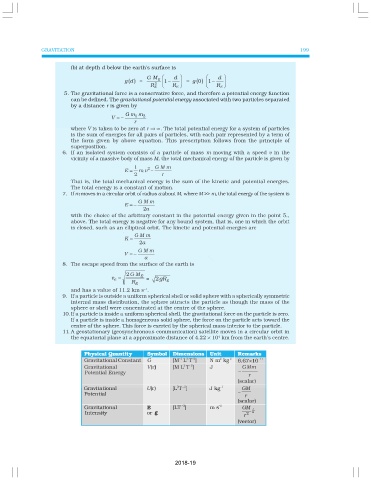
(b) at depth d below the earth’s surface is
G M d d
g d ( ) = E 1 − = g ( ) 10 −
R E 2 R R
E
E
5. The gravitational force is a conservative force, and therefore a potential energy function
can be defined. The gravitational potential energy associated with two particles separated
by a distance r is given by
G m m 2
1
V −
=
r
where V is taken to be zero at r → ∞. The total potential energy for a system of particles
is the sum of energies for all pairs of particles, with each pair represented by a term of
the form given by above equation. This prescription follows from the principle of
superposition.
6. If an isolated system consists of a particle of mass m moving with a speed v in the
vicinity of a massive body of mass M, the total mechanical energy of the particle is given by
1 2 G M m
E m v −
=
2 r
That is, the total mechanical energy is the sum of the kinetic and potential energies.
The total energy is a constant of motion.
7. If m moves in a circular orbit of radius a about M, where M >> m, the total energy of the system is
G M m
E −
=
2 a
with the choice of the arbitrary constant in the potential energy given in the point 5.,
above. The total energy is negative for any bound system, that is, one in which the orbit
is closed, such as an elliptical orbit. The kinetic and potential energies are
G M m
=
K
2 a
G M m
V −
=
a
8. The escape speed from the surface of the earth is
G 2 M
v = E = 2gR
e
R E E
–1
and has a value of 11.2 km s .
9. If a particle is outside a uniform spherical shell or solid sphere with a spherically symmetric
internal mass distribution, the sphere attracts the particle as though the mass of the
sphere or shell were concentrated at the centre of the sphere.
10. If a particle is inside a uniform spherical shell, the gravitational force on the particle is zero.
If a particle is inside a homogeneous solid sphere, the force on the particle acts toward the
centre of the sphere. This force is exerted by the spherical mass interior to the particle.
11. A geostationary (geosynchronous communication) satellite moves in a circular orbit in
4
the equatorial plane at a approximate distance of 4.22 × 10 km from the earth’s centre.
2018-19

