


Page 39 - Class-11-Physics-Part-1_Neat
P. 39
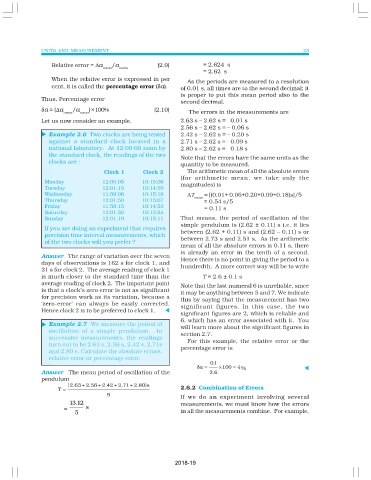
UNITS AND MEASUREMENT                                                                       25

                   Relative error = ∆a   /a              (2.9)           = 2.624  s
                                     mean  mean
                                                                         = 2.62  s
                   When the relative error is expressed in per     As the periods are measured to a resolution
                   cent, it is called the percentage error (δa).  of 0.01 s, all times are to the second decimal; it
                                                                 is proper to put this mean period also to the
                Thus, Percentage error
                                                                 second decimal.
                δa = (∆a   /a   ) × 100%                (2.10)
                        mean  mean                                  The errors in the measurements are
                Let us now consider an example.                  2.63 s – 2.62 s =   0.01 s
                                                                 2.56 s – 2.62 s = – 0.06 s
                  Example 2.6  Two clocks are being tested       2.42 s – 2.62 s = – 0.20 s
                 t
                  against a standard clock located in a          2.71 s – 2.62 s =    0.09 s
                  national laboratory.  At 12:00:00 noon by      2.80 s – 2.62 s =    0.18 s
                  the standard clock, the readings of the two    Note that the errors have the same units as the
                  clocks are :                                   quantity to be measured.

                                      Clock 1       Clock 2        The arithmetic mean of all the absolute errors
                                                                 (for arithmetic mean, we take only the
                 Monday              12:00:05      10:15:06      magnitudes) is
                 Tuesday             12:01:15      10:14:59
                 Wednesday           11:59:08      10:15:18        ∆Τ     = [(0.01+ 0.06+0.20+0.09+0.18)s]/5
                                                                      mean
                 Thursday            12:01:50      10:15:07                    = 0.54 s/5
                 Friday              11:59:15      10:14:53                    = 0.11 s
                 Saturday            12:01:30      10:15:24
                 Sunday              12:01:19      10:15:11      That means, the period of oscillation of the
                                                                 simple pendulum is (2.62 ± 0.11) s i.e. it lies
                 If you are doing an experiment that requires
                 precision time interval measurements, which     between (2.62 + 0.11) s and (2.62 – 0.11) s or
                 of the two clocks will you prefer ?             between 2.73 s and 2.51 s.  As the arithmetic
                                                                 mean of all the absolute errors is 0.11 s, there
                                                                 is already an error in the tenth of a second.
                Answer   The range of variation over the seven   Hence there is no point in giving the period to a
                days of observations is 162 s for clock 1, and   hundredth.  A more correct way will be to write
                31 s for clock 2.  The average reading of clock 1
                is much closer to the standard time than the                  T = 2.6 ± 0.1 s
                average reading of clock 2.  The important point  Note that the last numeral 6 is unreliable, since
                is that a clock’s zero error is not as significant  it may be anything between 5 and 7. We indicate
                for precision work as its variation, because a   this by saying that the measurement has two
                ‘zero-error’ can always be easily corrected.     significant figures. In this case, the two
                Hence clock 2 is to be preferred to clock 1.   t
                                                                 significant figures are 2, which is reliable and
                                                                 6, which has an error associated with it.  You
                  Example 2.7  We measure the period of          will learn more about the significant figures in
                 t
                  oscillation of a simple pendulum.     In       section 2.7.
                  successive measurements, the readings            For this example, the relative error or the
                  turn out to be 2.63 s, 2.56 s, 2.42 s, 2.71s   percentage error is
                  and 2.80 s. Calculate the absolute errors,
                  relative error or percentage error.
                                                                             .
                                                                           01
                                                                       δa =    ×100  = 4 %                     t
                Answer   The mean period of oscillation of the             2.6
                pendulum
                              +
                                    +
                         (2.63 2.56 2.42  + 2.71 2.80 )s
                                               +
                     T =                                         2.6.2  Combination of Errors
                                       5                         If we do an experiment involving several
                          13.12                                  measurements, we must know how the errors
                        =       s
                            5                                    in all the measurements combine.  For example,


                                                               2018-19

