


Page 40 - Class-11-Physics-Part-1_Neat
P. 40
26                                                                                     PHYSICS

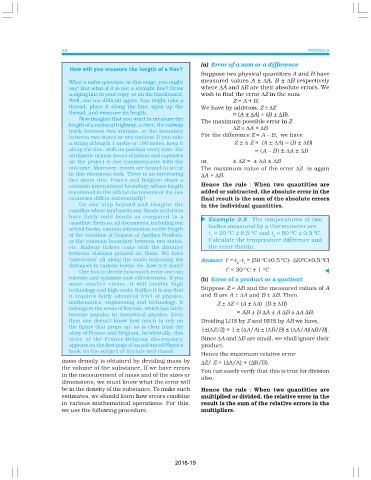
                                                                        (a)  Error of a sum or a difference
                          How will you measure the length of a line?
                                                                        Suppose two physical quantities A and B have
                         What a naïve question, at this stage, you might  measured values A ± ∆A, B ± ∆B respectively
                         say! But what if it is not a straight line? Draw  where ∆A and ∆B are their absolute errors. We
                         a zigzag line in your copy, or on the blackboard.  wish to find the error ∆Z in the sum
                         Well, not too difficult again. You might take a            Z = A + B.
                         thread, place it along the line, open up the   We have by addition, Z ± ∆Z
                         thread, and measure its length.                            = (A ± ∆A) + (B ± ∆B).
                             Now imagine that you want to measure the
                         length of a national highway, a river, the railway  The maximum possible error in Z
                         track between two stations, or the boundary                ∆Z = ∆A + ∆B
                         between two states or two nations. If you take  For the difference Z = A – B,  we have
                         a string of length 1 metre or 100 metre, keep it                      Z ± ∆ Z =  (A ± ∆A) – (B ± ∆B)
                         along the line, shift its position every time, the                                  = (A – B) ± ∆A ± ∆B
                         arithmetic of man-hours of labour and expenses
                         on the project is not commensurate with the    or,         ± ∆Z =  ± ∆A ± ∆B
                         outcome. Moreover, errors are bound to occur   The maximum value of the error ∆Z  is again
                         in this enormous task. There is an interesting  ∆A + ∆B.
                         fact about this. France and Belgium share a
                         common international boundary, whose length    Hence the rule   : When two quantities are
                         mentioned in the official documents of the two  added or subtracted, the absolute error in the
                         countries differs substantially!               final result is the sum of the absolute errors
                             Go one step beyond and imagine the         in the individual quantities.
                         coastline where land meets sea. Roads and rivers
                         have fairly mild bends as compared to a                          The temperatures of two
                         coastline. Even so, all documents, including our  t  Example 2.8
                         school books, contain information on the length   bodies measured by a thermometer are 0
                                                                                          0
                                                                                                        0
                                                                                  0
                         of the coastline of Gujarat or Andhra Pradesh,    t  = 20  C ± 0.5  C and t  = 50  C ± 0.5  C.
                                                                            1
                                                                                                  2
                         or the common boundary between two states,        Calculate the temperature difference and
                         etc. Railway tickets come with the distance       the error theirin.
                         between stations printed on them. We have
                         ‘milestones’ all along the roads indicating the  Answer  t′ = t –t  = (50  C±0.5  C)– (20 C±0.5  C)
                                                                                                            0
                                                                                                                   0
                                                                                                     0
                                                                                              0
                         distances to various towns. So, how is it done?             2  1
                                                                                        0
                                                                                              0
                             One has to decide how much error one can            t′ = 30  C ± 1  C                  t
                         tolerate and optimise cost-effectiveness. If you  (b)  Error of a product or a quotient
                         want smaller errors, it will involve high
                         technology and high costs. Suffice it to say that  Suppose Z = AB and the measured values of A
                         it requires fairly advanced level of physics,  and B are A ± ∆A and B ± ∆B. Then
                         mathematics, engineering and technology. It          Z ± ∆Z = (A ± ∆A)  (B ± ∆B)
                         belongs to the areas of fractals, which has lately
                         become popular in theoretical physics. Even                         = AB ± B ∆A ± A ∆B ± ∆A ∆B.
                         then one doesn’t know how much to rely on      Dividing LHS by Z and RHS by AB we have,
                         the figure that props up, as is clear from the  1±(∆Z/Z) = 1 ± (∆A/A) ± (∆B/B) ± (∆A/A)(∆B/B).
                         story of France and Belgium. Incidentally, this
                         story of the France-Belgium discrepancy        Since ∆A and ∆B are small, we shall ignore their
                         appears on the first page of an advanced Physics  product.
                         book on the subject of fractals and chaos!
                                                                        Hence the maximum relative error
                       mass density is obtained by deviding mass by     ∆Z/ Z = (∆A/A) + (∆B/B).
                       the volume of the substance. If we have errors   You can easily verify that this is true for division
                       in the measurement of mass and of the sizes or   also.
                       dimensions, we must know what the error will
                       be in the density of the substance. To make such  Hence the rule  : When two quantities are
                       estimates, we should learn how errors combine    multiplied or divided, the relative error in the
                       in various mathematical operations. For this,    result is the sum of the relative errors in the
                       we use the following procedure.                  multipliers.


                                                               2018-19

