


Page 58 - The Atlas of Economic Complexity
P. 58
MAPPING PATHS TO PROSPERITY  |  59


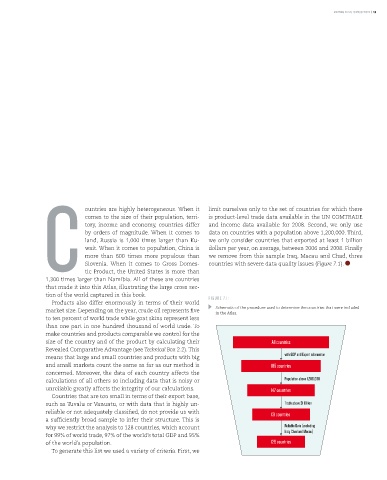
                 C               ountries are highly heterogeneous. When it    limit ourselves only to the set of countries for which there


                                                                               is product-level trade data available in the UN COMTRADE
                                 comes to the size of their population, terri-
                                                                               and  income  data  available  for  2008.  Second,  we  only  use
                                 tory,  income  and  economy,  countries  differ
                                                                               data on countries with a population above 1,200,000. Third,
                                 by  orders  of  magnitude. When  it  comes  to
                                 land,  Russia  is  1,000  times  larger  than  Ku-
                                                                               we only consider countries that exported at least 1 billion
                                 wait. When it comes to population, China is
                                                                               dollars per year, on average, between 2006 and 2008. Finally
                                 more  than  600  times  more  populous  than
                                 Slovenia.  When  it  comes  to  Gross  Domes-
                                                                               countries with severe data quality issues (Figure 7.1).
                                 tic Product, the United States is more than
                  1,300 times larger than Namibia. All of these are countries   we remove from this sample Iraq, Macau and Chad, three
                  that made it into this Atlas, illustrating the large cross sec-
                  tion of the world captured in this book.
                                                                               FIGURE 7.1:
                    Products also differ enormously in terms of their world
                                                                                 Schematic of the procedure used to determine the countries that were included
                  market size. Depending on the year, crude oil represents five   in the Atlas.
                  to ten percent of world trade while goat skins represent less
                  than one part in one hundred thousand of world trade. To
                  make countries and products comparable we control for the
                  size of the country and of the product by calculating their                         All countries
                  Revealed Comparative Advantage (see Technical Box 2.2). This
                                                                                                           with GDP and Export information
                  means that large and small countries and products with big
                  and small markets count the same as far as our method is                            185 countries
                  concerned. Moreover, the data of each country affects the
                  calculations of all others so including data that is noisy or                            Population above 1,200,000
                  unreliable greatly affects the integrity of our calculations.                       147 countries
                    Countries that are too small in terms of their export base,
                  such as Tuvalu or Vanuatu, or with data that is highly un-                               Trade above $1 Billion
                  reliable or not adequately classified, do not provide us with
                                                                                                      131 countries
                  a sufficiently broad sample to infer their structure. This is
                  why we restrict the analysis to 128 countries, which account                             Reliable Data (excluding
                                                                                                           Iraq, Chad and Macau)
                  for 99% of world trade, 97% of the world’s total GDP and 95%
                  of the world’s population.                                                          128 countries
                    To generate this list we used a variety of criteria. First, we

