


Page 53 - The Atlas of Economic Complexity
P. 53
54  |  THE ATLAS OF ECONOMIC COMPLEXITY


          t e c h n I c a l   B o x   5 . 4 :   u n d e r s ta n d I n g   t h e   p o s I t I o n   o f   c o u n t r I e s   I n   t h e
          p r o d u c t   s pa c e :   d I s ta n c e ,   o p p o r t u n I t y   va l u e   a n d   o p p o r t u n I t y   g a I n


            empirically, we find that countries move through the product space by deve-  are. We can think of this as the value of the option to move into other products.
          loping goods close to those they currently produce. But countries do not make   hence, to quantify the “opportunity value” of a country’s unexploited pros-
          just one product; they make a certain number. proximity measures the simila-  pects we can add the level of complexity of the products that it is not currently
          rity between a pair of products, so we need another measure to quantify the   weighted by how close these products are to the country’s current export suite.
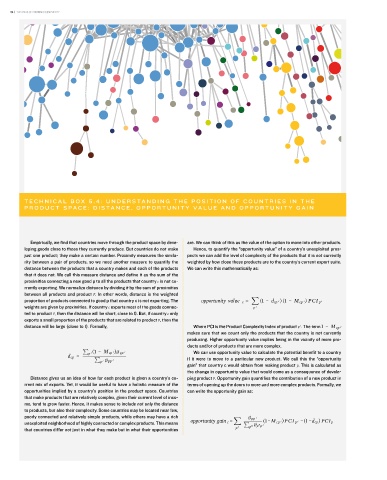
          distance between the products that a country makes and each of the products   We can write this mathematically as:
          that it does not. We call this measure distance and define it as the sum of the
          proximities connecting a new good p to all the products that country   is not cu-
          rrently exporting. We normalize distance by dividing it by the sum of proximities
          between all products and product  . in other words, distance is the weighted
          proportion of products connected to good p that country c is not exporting. the
          weights are given by proximities. if country   exports most of the goods connec-
          ted to product  , then the distance will be short, close to 0. But, if country   only
          exports a small proportion of the products that are related to product  , then the
          distance will be large (close to 1). Formally,                 Where pCi is the product Complexity index of product  . the term
                                                                       makes sure that we count only the products that the country is not currently
                                                                       producing. higher opportunity value implies being in the vicinity of more pro-
                                                                       ducts and/or of products that are more complex.
                                                                         We can use opportunity value to calculate the potential benefit to a country
                                                                       if it were to move to a particular new product. We call this the “opportunity
                                                                       gain” that country c would obtain from making product  . this is calculated as
                                                                       the change in opportunity value that would come as a consequence of develo-
            Distance gives us an idea of how far each product is given a country’s cu-  ping product  . opportunity gain quantifies the contribution of a new product in
          rrent mix of exports. yet, it would be useful to have a holistic measure of the   terms of opening up the doors to more and more complex products. Formally, we
          opportunities implied by a country’s position in the product space. Countries   can write the opportunity gain as:
          that make products that are relatively complex, given their current level of inco-
          me, tend to grow faster. hence, it makes sense to include not only the distance
          to products, but also their complexity. some countries may be located near few,
          poorly connected and relatively simple products, while others may have a rich
          unexploited neighborhood of highly connected or complex products. this means
          that countries differ not just in what they make but in what their opportunities

