


Page 13 - NCUK Brochure
P. 13
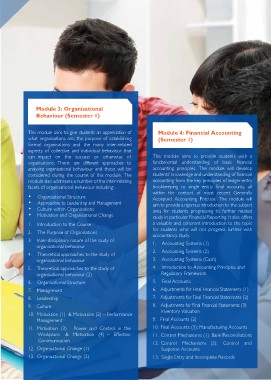
Module 3: Organisational                            Module 4: Financial Accounting
    Behaviour (Semester 1)                              (Semester 1)

This module aims to give students an appreciation of  This module aims to provide students with a
what organisations are, the purpose of establishing   fundamental understanding of basic financial
formal organisations and the many inter-related       accounting principles. The module will develop
aspects of collective and individual behaviour that   students’ knowledge and understanding of financial
can impact on the success or otherwise of             accounting from the key principles of ledger entry
organisations. There are different approaches to      bookkeeping to single entity final accounts, all
analysing organisational behaviour and these will be  within the context of most recent Generally
considered during the course of this module. The      Accepted Accounting Practice. The module will
module also addresses a number of the inter-relating  aim to provide a rigorous introduction to the subject
facets of organisational behaviour including:         area for students progressing to further related
                                                      study in particular Financial Reporting. It also offers
• Organisational Structure                            a valuable and coherent introduction to the topic
• Approaches to Leadership and Management             for students who will not progress further with
• Culture within Organisations                        accountancy study.
• Motivation and Organisational Change
                                                      1. Accounting Systems (1)
1. Introduction to the Course
                                                      2. Accounting Systems (2)
2. The Purpose of Organisations
                                                      3. Accounting Systems (Cash)
3. Inter-disciplinary nature of the study of
     organisational behaviour                         4. Introduction to Accounting Principles and
                                                           Regulatory Framework
4. Theoretical approaches to the study of
     organisational behaviour                         5. Final Accounts

5. Theoretical approaches to the study of             6. Adjustments for Final Financial Statements (1)
     organisational behaviour (2)
                                                      7. Adjustments for Final Financial Statements (2)
6. Organisational Structure
                                                      8. Adjustments for Final Financial Statements (3):
7. Management                                              Inventory Valuation

8. Leadership                                         9. Final Accounts (2)

9. Culture                                            10. Final Accounts (3): Manufacturing Accounts

10. Motivation (1) & Motivation (2) – Performance     11. Control Mechanisms (1): Bank Reconciliations
     Management
                                                      12. Control Mechanisms (2): Control and
11. Motivation (3) – Power and Control in the              Suspense Accounts
     Workplace & Motivation (4) – Effective
     Communication                                    13. Single Entry and Incomplete Records

12. Organisational Change (1)

13. Organisational Change (2)

