Page 16 - Engineering Mathematics Workbook_Final
P. 16
Calculus

                                                                       − + − + − +
                                                                                                    ( 2n
                        f
                                                    x
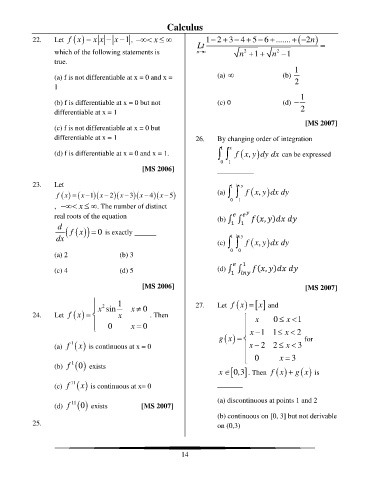
            22.    Let  ( ) x =  x x −  x − 1 , −                1 2 3 4 5 6 .......+ −              )
                                                                  Lt                                       =
                                                                                  2
                   which of the following statements is           n→           n +  1 +   n −  1
                                                                                             2
                   true.
                                                                                                   1
                   (a) f is not differentiable at x = 0 and x =          (a)                  (b)   2
                   1
                                                                                                    1
                   (b) f is differentiable at x = 0 but not              (c) 0                 (d) −
                   differentiable at x = 1                                                          2
                                                                                                      [MS 2007]
                   (c) f is not differentiable at x = 0 but
                   differentiable at x = 1                        26.    By changing order of integration
                                                                                      )
                   (d) f is differentiable at x = 0 and x = 1.             1 ex  f  ( ,x y dy dx can be expressed
                                                                          0  1
                                                [MS 2006]                __________

            23.    Let                                                       1  ln y
                                                                                         )
                    f x =      1 )( x − 2 )(x − 3 )(x −  4 )(x −  ) 5     (a)     f  ( , x y dx dy
                     ( ) ( x −
                                                                             0  1
                           x
                   ,  −  . The number of distinct
                                                                                
                   real roots of the equation                            (b) ∫ ∫          (  ,   )         
                    d                                                        1   1
                    dx ( f  ( )) 0x =  is exactly ______                     1  ln y
                                                                                         )
                                                                         (c)     f  ( , x y dx dy
                                                                             0  0
                   (a) 2                 (b) 3
                                                                                  1
                   (c) 4                 (d) 5                           (d) ∫ ∫          (  ,   )         
                                                                             1
                                                [MS 2006]                                             [MS 2007]

                                  2    1                         27.    Let  ( )   x  and
                                                                              f x =
                                
                                
                        f
            24.    Let  ( ) x =  x  sin  x  x   0  . Then                       
                                                                                   x      0   x   1
                                    0      x =  0                                
                                
                                                                                             
                                                                                  
                                                                                  
                                                                         g ( ) x =   x − 1 1 x   2   for
                         1
                                                                                                x
                       f
                   (a)  ( ) x  is continuous at x = 0                              x −  2 2      3
                                                                                  
                                                                                    0        x =  3
                                                                                  
                                                                                  
                   (b)  ( ) 0f  1   exists
                                                                         x    . Then  ( ) x +   g  ( ) x  is
                                                                              0,3
                                                                                           f
                   (c)  f  11 ( ) x  is continuous at x= 0               _______
                   (d)  f  11 ( ) 0  exists      [MS 2007]               (a) discontinuous at points 1 and 2
                                                                         (b) continuous on [0, 3] but not derivable
            25.                                                          on (0,3)


                                                             14
   11   12   13   14   15   16   17   18   19   20   21