Page 13 - Engineering Mathematics Workbook_Final
P. 13
Calculus

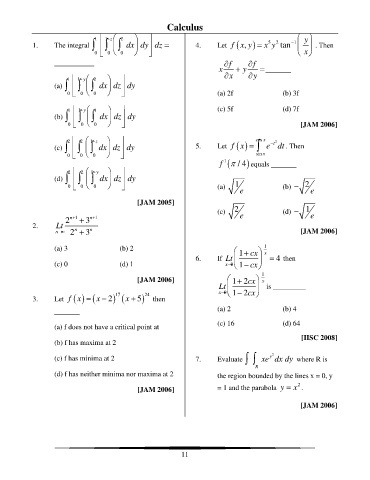
                                1   1 z   −  2                                                   y 
                                                   
                                                
                                                  
                                                                                     )
                                              
                                                                                          5
                                                                              f
            1.     The integral           dx dy dz =          4.     Let  ( , x y =  x y 2  tan − 1           . Then
                                0   0    0                                                     x 
                   ___________                                               f      f 
                                                                         x     +  y    =  _______
                       1   1 y   −  2                                    x      y
                                       
                                          
                                     
                                         
                   (a)            dx dz dy
                       0   0    0                                  (a) 2f                (b) 3f
                       1   1 y   −  1                                (c) 5f                (d) 7f
                                       
                                          
                                     
                                         
                   (b)            dx dz dy
                       0   0    0                                                             [JAM 2006]
                       2   2   1 z                                                cos x  t −  2
                                −
                                      
                                          
                                         
                                    
                                                                              f
                   (c)           dx dz dy                     5.     Let  ( ) x =    e dt . Then
                       0   0    0                                               sin x
                                                                           1
                                                                          f       )
                                                                            ( / 4 equals _______
                       2   2   1 y    
                                −
                                          
                                         
                                       
                                     
                   (d)           dx dz dy
                       0   0    0                                  (a)   1 e             (b) −  2 e
                                              [JAM 2005]
                                                                         (c)   2 e             (d) −  1 e
                       2 n +  1  +  3 n +  1
            2.      Lt
                          n
                   n→   2 +  3 n                                                                   [JAM 2006]
                   (a) 3                 (b) 2                                  1 cx   1 x 
                                                                                  +
                                                                  6.     If  Lt             =  4 then
                                                                                  −
                   (c) 0                 (d) 1                              x→ 0   1 cx 
                                                                                +
                                              [JAM 2006]                      1 2cx    1 x 
                                                                         Lt     −          is _________
                                       17
                        f x =
            3.     Let  ( ) (x −     2 ) (x +   ) 5  24  then            x→ 0   1 2cx 
                   _______                                               (a) 2                 (b) 4
                   (a) f does not have a critical point at               (c) 16                (d) 64
                                                                                                     [IISC 2008]
                   (b) f has maxima at 2
                                                                                           2
                                                                                          y
                   (c) f has minima at 2                          7.     Evaluate     xe dx dy  where R is
                                                                                     R
                   (d) f has neither minima nor maxima at 2              the region bounded by the lines x = 0, y
                                                                                                    2
                                              [JAM 2006]                 = 1 and the parabola  y =  x .

                                                                                                    [JAM 2006]


                                                             11
   8   9   10   11   12   13   14   15   16   17   18