


Page 108 - 657465 _ 0002-0003.indd
P. 108
Grammar Reference  Unit  1


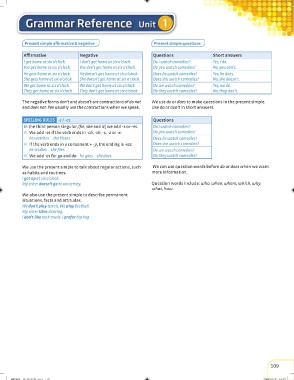
            Present simple affirmative & negative                   Present simple questions

           Affirmative              Negative                       Questions                 Short answers
           I get home at six o'clock.  I don’t get home at six o'clock.  Do I watch comedies?  Yes, I do.
           You get home at six o'clock.  You don’t get home at six o'clock.  Do you watch comedies?  No, you don't.
           He gets home at six o'clock.  He doesn’t get home at six o'clock.  Does he watch comedies?  Yes, he does.
           She gets home at six o'clock.  She doesn’t get home at six o'clock.  Does she watch comedies?  No, she doesn't.
           We get home at six o'clock.  We don’t get home at six o'clock.  Do we watch comedies?  Yes, we do.
           They get home at six o'clock.  They don’t get home at six o'clock.  Do they watch comedies?  No, they don't.

           The negative forms don’t and doesn’t are contractions of do not   We use do or does to make questions in the present simple.
           and does not. We usually use the contractions when we speak.  Use do or don't in short answers.


           SPELLING RULES    -s / -es                              Questions
           In the third person singular, (he, she and it) we add -s or -es.  Do I watch comedies?
           ●  We add -es if the verb ends in -ch, -sh, -s, -z or -x:   Do you watch comedies?
              he watches     she kisses                            Does he watch comedies?
           ●  If the verb ends in a consonant + -y, the ending is -ies:      Does she watch comedies?
              he studies     she flies                             Do we watch comedies?
           ●  We add -es for go and do:   he goes     she does     Do they watch comedies?

           We use the present simple to talk about regular actions, such    We can use question words before do or does when we want
           as habits and routines.                                 more information.
           I get up at six o'clock.
           My sister doesn’t go to university.                     Question words include: who, when, where, which, why,
                                                                   what, how.
           We also use the present simple to describe permanent
           situations, facts and attitudes.
           We don’t play tennis. We play football.
           My sister likes dancing.
           I don’t like rock music. I prefer hip hop.


                                                                                                                      109
                                                                                                                      113

      657465 _ 0113-0121.indd   113                                                                                17/05/2017   14:27

