


Page 109 - 657465 _ 0002-0003.indd
P. 109
Grammar Reference  Unit  2


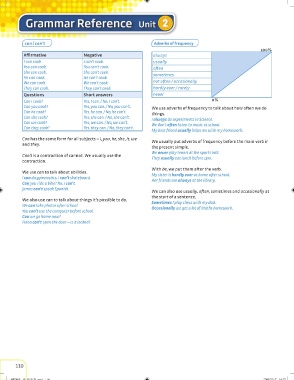
            can / can’t                                             Adverbs of frequency
                                                                                                                  100%
           Affirmative               Negative                      always
           I can cook.               I can’t cook.                 usually
           You can cook.             You can't cook.               often
           She can cook.             She can’t cook.               sometimes
           He can cook.              He can't cook.
           We can cook.              We can't cook.                not often / occasionally
           They can cook.            They can't cook.              hardly ever / rarely
           Questions                 Short answers                 never
           Can I cook?               Yes, I can. / No, I can’t.                              0%
           Can you cook?             Yes, you can. / No, you can’t.  We use adverbs of frequency to talk about how often we do
           Can he cook?              Yes, he can. / No, he can’t.  things.
           Can she cook?             Yes, she can. / No, she can’t.  I always do experiments in Science.
           Can we cook?              Yes, we can. / No, we can’t.  We don’t often listen to music at school.
           Can they cook?            Yes, they can. / No, they can’t.
                                                                   My best friend usually helps me with my homework.
           Can has the same form for all subjects – I, you, he, she, it, we   We usually put adverbs of frequency before the main verb in
           and they.
                                                                   the present simple.
                                                                   We never play tennis at the sports hall.
           Can’t is a contraction of cannot. We usually use the    They usually eat lunch before 1pm.
           contraction.
                                                                   With be, we put them after the verb.
           We use can to talk about abilities.                     My sister is hardly ever at home after school.
           I can do gymnastics. I can’t skateboard.                Her friends are always at the library.
           Can you ride a bike? No, I can't.
           James can't speak Spanish.
                                                                   We can also use usually, often, sometimes and occasionally at
                                                                   the start of a sentence.
           We also use can to talk about things it’s possible to do.  Sometimes I play chess with my dad.
           We can take photos after school.                        Occasionally we get a lot of Maths homework.
           You can’t use the computer before school.
           Can we go home now?
           Fiona can't open the door – is it locked?


        110
        114

      657465 _ 0113-0121.indd   114                                                                                17/05/2017   14:27

