


Page 112 - 657465 _ 0002-0003.indd
P. 112
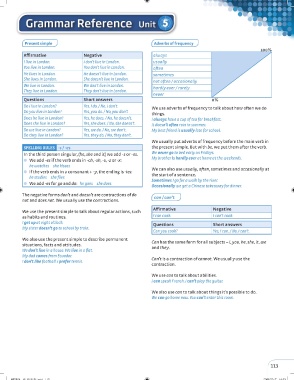
Grammar Reference  Unit                                    5


            Present simple                                          Adverbs of frequency
                                                                                                                  100%
           Affirmative               Negative                      always
           I live in London.         I don’t live in London.       usually
           You live in London.       You don’t live in London.     often
           He lives in London.       He doesn’t live in London.    sometimes
           She lives in London.      She doesn’t live in London.   not often / occasionally
           We live in London.        We don’t live in London.      hardly ever / rarely
           They live in London.      They don’t live in London.
                                                                   never
           Questions                 Short answers                                           0%
           Do I live in London?      Yes, I do. / No, I don’t.     We use adverbs of frequency to talk about how often we do
           Do you live in London?    Yes, you do. / No, you don’t
                                                                   things.
           Does he live in London?   Yes, he does. / No, he doesn’t.  I always have a cup of tea for breakfast.
           Does she live in London?  Yes, she does. / No, she doesn’t.  It doesn’t often rain in summer.
           Do we live in London?     Yes, we do. / No, we don’t.   My best friend is usually late for school.
           Do they live in London?   Yes, they do. / No, they don’t.
                                                                   We usually put adverbs of frequency before the main verb in
           SPELLING RULES    -s / -es                              the present simple. But with be, we put them after the verb.
           In the third person singular, (he, she and it) we add -s or -es.  We never go to bed early on Fridays.
           ●  We add -es if the verb ends in -ch, -sh, -s, -z or -x:   My brother is hardly ever at home at the weekends.
              he watches     she kisses
           ●  If the verb ends in a consonant + -y, the ending is -ies:      We can also use usually, often, sometimes and occasionally at
                                                                   the start of a sentence.
              he studies     she flies                             Sometimes I go for a walk by the river.
           ●  We add -es for go and do:   he goes     she does
                                                                   Occasionally we get a Chinese takeaway for dinner.
           The negative forms don’t and doesn’t are contractions of do   can / can’t
           not and does not. We usually use the contractions.
                                                                   Affirmative               Negative
           We use the present simple to talk about regular actions, such
           as habits and routines.                                 I can cook.               I can’t cook.
           I get up at eight o’clock.                              Questions                 Short answers
           My sister doesn’t go to school by train.
                                                                   Can you cook?             Yes, I can. / No, I can’t.
           We also use the present simple to describe permanent    Can has the same form for all subjects – I, you, he, she, it, we
           situations, facts and attitudes.                        and they.
           We don’t live in a house. We live in a flat.
           My dad comes from Ecuador.                              Can’t is a contraction of cannot. We usually use the
           I don’t like football. I prefer tennis.                 contraction.

                                                                   We use can to talk about abilities.
                                                                   I can speak French. I can’t play the guitar.

                                                                   We also use can to talk about things it’s possible to do.
                                                                   We can go home now. You can’t enter this room.


                                                                                                                      113


      657594 _ 0113-0121.indd   113                                                                                17/05/2017   14:30

