


Page 50 - VMFT News Letter _Ajeesh_New Design_26.03.2020_Copy Revised
P. 50
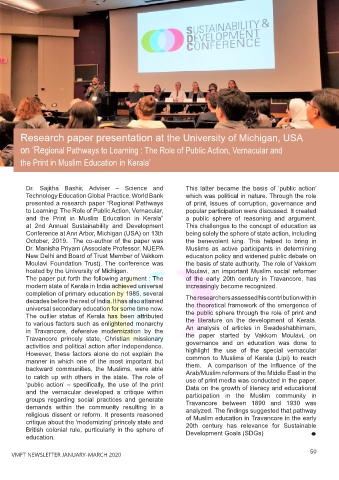
Research paper presentation at the University of Michigan, USA

        on ‘Regional Pathways to Learning : The Role of Public Action, Vernacular and
        the Print in Muslim Education in Kerala’


          Dr. Sajitha  Bashir,  Adviser  – Science  and           This latter became the basis of ‘public action’
          Technology Education Global Practice, World Bank        which was political in nature. Through the role
          presented a research paper “Regional Pathways           of print, issues of corruption, governance and
          to Learning: The Role of Public Action, Vernacular,     popular participation were discussed. It created
          and  the Print in Muslim  Education  in Kerala”         a public sphere of reasoning  and argument.
          at 2nd  Annual Sustainability  and Development          This challenges to the concept of education as
          Conference at Ann Arbor, Michigan (USA) on 13th         being solely the sphere of state action, including
          October, 2019.  The co-author of the paper was          the benevolent  king.  This helped  to bring  in
          Dr. Manisha Priyam (Associate Professor, NUEPA          Muslims  as active participants  in determining
          New Delhi and Board of Trust Member of Vakkom           education policy and widened public debate on
          Moulavi Foundation Trust). The conference was           the basis of state authority. The role of Vakkom
          hosted by the University of Michigan.                   Moulavi, an important Muslim social reformer
          The paper put forth the following argument : The        of the early  20th century in  Travancore,  has
          modern state of Kerala in India achieved universal      increasingly become recognized.
          completion of primary education by 1985, several
          decades before the rest of India. It has also attained   The researchers assessed his contribution within
          universal secondary education for some time now.        the theoretical framework of the emergence of
          The outlier status of Kerala  has been  attributed      the public sphere through the role of print and
          to various factors such as enlightened monarchy         the  literature on the  development of  Kerala.
          in  Travancore,  defensive  modernization  by the       An analysis of  articles in Swadeshabhimani,
          Travancore princely state,  Christian missionary        the paper started by Vakkom Moulavi, on
          activities and political action after independence.     governance  and on education was done to
          However, these factors alone do not explain the         highlight  the use of the special  vernacular
          manner  in which one of the most important but          common to Muslims of Kerala  (Lipi)  to reach
          backward  communities, the Muslims, were able           them.    A  comparison  of  the  influence  of  the
                                                                  Arab/Muslim reformers of the Middle East in the
          to catch up with others in the state.  The role of      use of print media was conducted in the paper.
          ‘public  action’  –  specifically,  the  use  of  the  print   Data on the growth of literacy and educational
          and the  vernacular developed a  critique within        participation  in the Muslim community in
          groups  regarding  social  practices and generate       Travancore  between  1890 and  1930  was
          demands  within  the community resulting  in a          analyzed. The findings suggested that pathway
          religious dissent or reform. It presents reasoned       of Muslim education in Travancore in the early
          critique about the ‘modernizing’ princely state and     20th century has relevance for Sustainable
          British colonial rule, purticularly in the sphere of    Development Goals (SDGs)
          education.

                                                                                                              50
     VMFT NEWSLETTER JANUARY-MARCH 2020

