


Page 49 - Advanced Course
P. 49
KNX ADVANCED COURSE

                  2.1  Individual Room Control
                  The individual room control system can be implemented relatively simply by the electrical
                  installer as only a small amount of specialist knowledge of the heating industry is required.
                  It is possible to distinguish between 2 types of individual room control:

                      2-step control
                      continuous control (3-step control)

                  In our examples, we are starting with hot water convector heating.


                  2.1.1  Principle of Individual Room Control
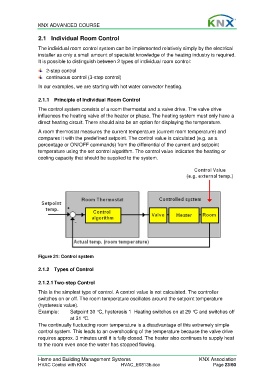
                  The control system consists of a room thermostat and a valve drive. The valve drive
                  influences the heating valve of the heater or phase. The heating system must only have a
                  direct heating circuit. There should also be an option for displaying the temperature.

                  A room thermostat measures the current temperature (current room temperature) and
                  compares it with the predefined setpoint. The control value is calculated (e.g. as a
                  percentage or ON/OFF commands) from the differential of the current and setpoint
                  temperature using the set control algorithm. The control value indicates the heating or
                  cooling capacity that should be supplied to the system.


                  Figure 21: Control system


                  2.1.2  Types of Control

                  2.1.2.1 Two-step Control

                  This is the simplest type of control. A control value is not calculated. The controller
                  switches on or off. The room temperature oscillates around the setpoint temperature
                  (hysteresis value).
                  Example:      Setpoint 30 °C, hysteresis 1  Heating switches on at 29 °C and switches off
                                at 31 °C.
                  The continually fluctuating room temperature is a disadvantage of this extremely simple
                  control system. This leads to an overshooting of the temperature because the valve drive
                  requires approx. 3 minutes until it is fully closed. The heater also continues to supply heat
                  to the room even once the water has stopped flowing.


                  Home and Building Management Systems                                    KNX Association
                  HVAC Control with KNX                HVAC_E0813b.doc                          Page 23/60

