


Page 80 - Advanced Course
P. 80
KNX ADVANCED COURSE


                  6  Physical Sensors


                  6.1  General

                  A sensor is a device that measures a physical quantity and converts it into a signal
                  readable by an observer or by an instrument. For example, in a mercury-in-glass
                  thermometer the expansion and contraction of a liquid determines the temperature
                  indicated on a calibrated glass tube. A thermocouple converts temperature to an output
                  voltage readable by a voltmeter. For accuracy, most sensors are calibrated against known
                  standards.
                  The term physical sensor is used to describe the category of sensors that measure
                  physical phenomena, such as weather conditions (i.e. temperature, brightness and/or
                  position of the sun, precipitation, wind, solar radiation) or air quality (i.e. CO 2
                  concentration, humidity, etc.).
                  Most of the KNX sensors include functions that make them powerful measuring devices.
                  These can be GPS functions, measurement calibration, hysteresis definition, logical
                  functions, timing functions, value recording, sending threshold and/or alarm values, etc.


                  6.2  Weather condition sensors


                  6.2.1 Temperature sensor
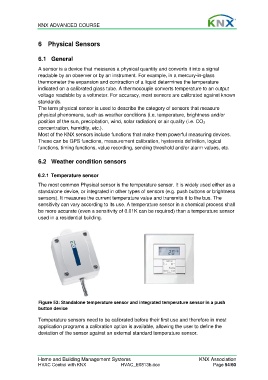
                  The most common Physical sensor is the temperature sensor. It is widely used either as a
                  standalone device, or integrated in other types of sensors (e.g. push buttons or brightness
                  sensors). It measures the current temperature value and transmits it to the bus. The
                  sensitivity can vary according to its use. A temperature sensor in a chemical process shall
                  be more accurate (even a sensitivity of 0.01K can be required) than a temperature sensor
                  used in a residential building.


                    Figure 53: Standalone temperature sensor and integrated temperature sensor in a push
                    button device

                  Temperature sensors need to be calibrated before their first use and therefore in most
                  application programs a calibration option is available, allowing the user to define the
                  deviation of the sensor against an external standard temperature sensor.


                  Home and Building Management Systems                                    KNX Association
                  HVAC Control with KNX                HVAC_E0813b.doc                          Page 54/60

