


Page 76 - Advanced Course
P. 76
KNX ADVANCED COURSE

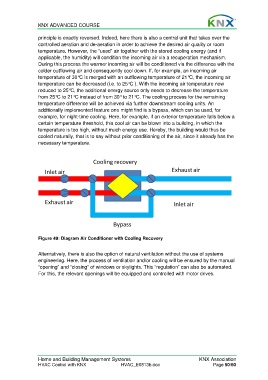
                  principle is exactly reversed. Indeed, here there is also a central unit that takes over the
                  controlled aeration and de-aeration in order to achieve the desired air quality or room
                  temperature. However, the “used” air together with the stored cooling energy (and if
                  applicable, the humidity) will condition the incoming air via a recuperation mechanism.
                  During this process the warmer incoming air will be conditioned via the difference with the
                  colder outflowing air and consequently cool down. If, for example, an incoming air
                  temperature of 30°C is merged with an outflowing temperature of 21°C, the incoming air
                  temperature can be decreased (i.e. to 25°C ). With the incoming air temperature now
                  reduced to 25°C, the additional energy source only needs to decrease the temperature
                  from 25°C to 21°C instead of from 30° to 21°C. The cooling process for the remaining
                  temperature difference will be achieved via further downstream cooling units. An
                  additionally implemented feature one might find is a bypass, which can be used, for
                  example, for night-time cooling. Here, for example, if an exterior temperature falls below a
                  certain temperature threshold, this cool air can be blown into a building, in which the
                  temperature is too high, without much energy use. Hereby, the building would thus be
                  cooled naturally, that is to say without prior conditioning of the air, since it already has the
                  necessary temperature.


                  Figure 49: Diagram Air Conditioner with Cooling Recovery


                  Alternatively, there is also the option of natural ventilation without the use of systems
                  engineering. Here, the process of ventilation and/or cooling will be ensured by the manual
                  “opening” and “closing” of windows or skylights. This “regulation” can also be automated.
                  For this, the relevant openings will be equipped and controlled with motor drives.


                  Home and Building Management Systems                                    KNX Association
                  HVAC Control with KNX                HVAC_E0813b.doc                          Page 50/60

