


Page 75 - Advanced Course
P. 75
KNX ADVANCED COURSE


                  5  Ventilation


                  5.1  Introduction

                  Due to increased requirements in terms of energy saving, new buildings have amongst
                  others become more and more air tight. This is done to minimize the loss of energy. When
                  buildings are built in this way, it becomes necessary to pay more attention to their
                  controlled aeration and de-aeration. Owing to the way the building is constructed, natural
                  ventilation is minimal, if not non-existent. This in turn requires paying special attention to
                  air quality. If this is disregarded it can lead to subsequent damage to humans and
                  buildings, in particular through the spreading of fungi, spores and bacteria. Through the
                  use of an automated ventilation system one can set a number of goals, including not
                  exceeding a set CO²-emission value, humidity, temperature, etc.


                  5.2  Technical Design

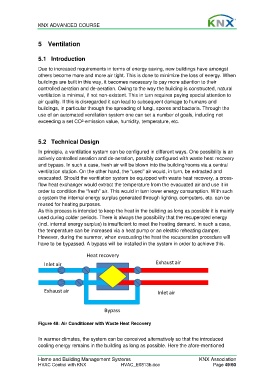
                  In principle, a ventilation system can be configured in different ways. One possibility is an
                  actively controlled aeration and de-aeration, possibly configured with waste heat recovery
                  and bypass. In such a case, fresh air will be blown into the building/rooms via a central
                  ventilation station. On the other hand, the “used” air would, in turn, be extracted and
                  evacuated. Should the ventilation system be equipped with waste heat recovery, a cross-
                  flow heat exchanger would extract the temperature from the evacuated air and use it in
                  order to condition the “fresh” air. This would in turn lower energy consumption. With such
                  a system the internal energy surplus generated through lighting, computers, etc. can be
                  reused for heating purposes.
                  As this process is intended to keep the heat in the building as long as possible it is mainly
                  used during colder periods. There is always the possibility that the recuperated energy
                  (incl. internal energy surplus) is insufficient to meet the heating demand. In such a case,
                  the temperature can be increased via a heat pump or an electric reheating damper.
                  However, during the summer, when evacuating the heat the recuperation procedure will
                  have to be bypassed. A bypass will be installed in the system in order to achieve this.


                  Figure 48: Air Conditioner with Waste Heat Recovery

                  In warmer climates, the system can be conceived alternatively so that the introduced
                  cooling energy remains in the building as long as possible. Here the afore-mentioned

                  Home and Building Management Systems                                    KNX Association
                  HVAC Control with KNX                HVAC_E0813b.doc                          Page 49/60

