


Page 92 - Advanced Course
P. 92
KNX ADVANCED COURSE

                           Example of logic applications
                           Logi kanwendungen -
                           B i        il                           T             dt


                     M   3/1 4/1         M 3/2 4/2             M   3/3 4/3


                        1/1  2/1              1/4 2/4              1/7 2/7

                        1/2  2/2              1/5 2/5              1/8 2/8
                                     Partition A           Partition B              0 ... Partition position

                        1/3  2/3              1/6 2/6              1/9 2/9          1 ... Lighting on/off
                                                                                    2 ... Dim lighting
                                                                                    3 ... Shutter up/down
                                                                                    4 ... Adjust louvres
                   Room 1                 Room 2               Room 3


                                    0/1                   0/2


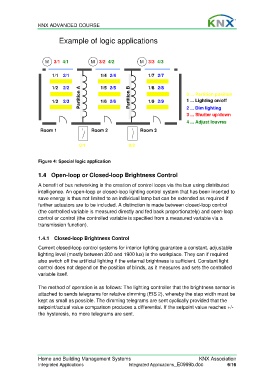
                  Figure 4: Special logic application

                  1.4  Open-loop or Closed-loop Brightness Control

                  A benefit of bus networking is the creation of control loops via the bus using distributed
                  intelligence. An open-loop or closed-loop lighting control system that has been inserted to
                  save energy is thus not limited to an individual lamp but can be extended as required if
                  further actuators are to be included. A distinction is made between closed-loop control
                  (the controlled variable is measured directly and fed back proportionately) and open-loop
                  control or control (the controlled variable is specified from a measured variable via a
                  transmission function).


                  1.4.1  Closed-loop Brightness Control

                  Current closed-loop control systems for interior lighting guarantee a constant, adjustable
                  lighting level (mostly between 200 and 1900 lux) in the workplace. They can if required
                  also switch off the artificial lighting if the external brightness is sufficient. Constant light
                  control does not depend on the position of blinds, as it measures and sets the controlled
                  variable itself.

                  The method of operation is as follows: The lighting controller that the brightness sensor is
                  attached to sends telegrams for relative dimming (EIS 2), whereby the step width must be
                  kept as small as possible. The dimming telegrams are sent cyclically provided that the
                  setpoint/actual value comparison produces a differential. If the setpoint value reaches +/-
                  the hysteresis, no more telegrams are sent.


                  Home and Building Management Systems                                   KNX Association
                  Integrated Applications                 Integrated Applications_E0999b.doc          6/16

