


Page 94 - Advanced Course
P. 94
KNX ADVANCED COURSE

                  1.4.2  Open-loop Brightness Control
                  An open-loop brightness control system is more cost-effective but takes more time to
                  adjust in order to achieve the same effect as constant light control. It is also not possible
                  to compensate for the effect of lowered shutters as the system uses the external
                  brightness level as a control value.
                  This type of control is however particularly suitable in larger installations for achieving
                  measurable energy savings with little effort. In contrast to the closed-loop control system,
                  the operation of the open-loop system is absolute. The necessary control value (8 bit –
                  EIS 6) for the lamps (switch/dim actuators or dimmers) is derived, with the additional help
                  of the control characteristic, from the received lighting level of the brightness sensor. It is
                  then output as a bus telegram. The automatic control system can be interrupted at any
                  time e.g. by manual intervention of the user or by lowering the blinds. An event- or time-
                  driven return to automatic control is also possible. Some actuators enable the lighting to
                  be switched on or off when presence is detected, without having an effect on the control
                  system. This means that one characteristic curve can be used for several load groups in
                  various rooms.

                            Helligkeitssteuerbaustei  - Konfiguration
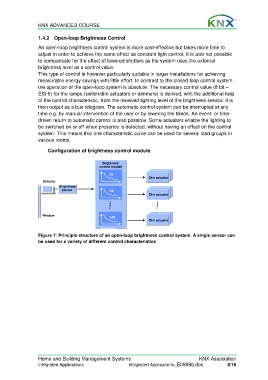
                      Configuration of brightness control module

                                                Brightness
                                             control module
                                                  S1
                                                                   Dim actuator
                    Detector
                           Brightness
                              sensor              S2
                                                                   Dim actuator


                    Window                        S10
                                                                   Dim actuator

                  Figure 7: Principle structure of an open-loop brightness control system. A single sensor can
                  be used for a variety of different control characteristics


                  Home and Building Management Systems                                   KNX Association
                  Integrated Applications                 Integrated Applications_E0999b.doc          8/16

