


Page 45 - Digital Electronics by harish
P. 45
Comparison of TTL and CMOS logic families


                    Sl. No.        Parameter                  TTL                      CMOS
                      1.     Power Supply voltage    5 volts                  3 to 15 volts
                      2.     Power dissipation       100 mW (milli watt)      10 nW (nano watt)
                      3.     Propagation delay       15 nsec (nano seconds)   25 nsec (nano seconds)
                      4.     Noise margin            0.4 volts                45% of V DD
                      5.     Fan-out                 10                       Greater than 50

               Applications of TTL and CMOS logic gates

                       TTL and CMOS logic gates are used in digital circuits, memories, etc. CMOS gates
               are preferred over TTL for lower power applications such as battery operated devices.

               1.5.5  Tristate Logic (TSL) gate

               We know only two logic states namely low level „0‟ and high level „1‟. But there is a third
               logic state which is called „high impedance‟ state. In this third state, even though the output is
               physically  connected  in  the  circuit,  it  behaves  like  an  open  circuit.  A  gate  with  high
               impedance state is called Tristate gate.

               Tristate Inverter Gate

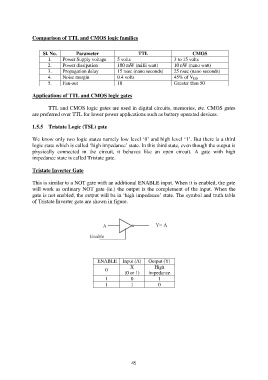
               This is similar to a NOT gate with an additional ENABLE input. When it is enabled, the gate
               will work as ordinary NOT gate (ie.) the output is the complement of the input. When the
               gate is not enabled, the output will be in „high impedance‟ state. The symbol and truth table
               of Tristate Inverter gate are shown in figure.


                                             ENABLE  Input (A)     Output (Y)
                                                           X          High
                                                0
                                                        (0 or 1)   impedance
                                                1          0           1
                                                1          1           0


                                                           45

