


Page 120 - History of The Quranic Text | Kalamullah.Com
P. 120
100           THE HISTORY OF THE QUR'ANIC TEXT

                                        i. Studies on the Mushaf of Malik bin AbI 'Amir al-Asbahi


                                   Here we delve into a comparison between 'Uthman's Mushaf and another,
                                   personal copy kept by a well-known scholar. Malik bin Anas (94-179 A.H.
                                   1712-795 C.E.) once handed this Mushaf to his students'" and recounted
                                   its history: it belonged to his grandfather, Malik bin AbI 'Amir al-Asbaht
                                   (d. 74 A.H.l693 C.E.), a student of Caliph 'Umar;" who had written it down
                                   during 'Uthman's preparation of the MU~.l:tafS.60 Malik bin Anas' students
                                   quickly noted some of its features:
                                         It was decorated with silver.
                                         It contained sura separators in black ink along an ornamental band,
                                         like a chain running along the entire line.
                                         It had ayah (verse) separators in the form of a dot,"!
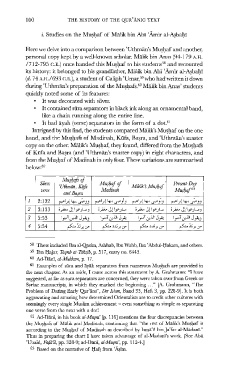
                                     Intrigued by this find, the students compared Malik's Mushaf on the one
                                   hand, and the Mushafs of Madinah, Kufa, Basra, and 'Uthman's master
                                   copy on the other. Malik's Mushaf, they found, differed from the Mushafs
                                   of Kufa and Basra (and 'Uthrnan's master copy) in eight characters, and
                                   from the Mushaf of Madinah in only four. These variations are summarised
                                   belowr'?

                                               MUJ~ifs of
                                        Sura:               MUJ~af of                 Present-Day
                                              'Uthmiin, Kiift.          Miilik's MUJ~af         I
                                        verse                Medinah                  MUJ~af63
                                                andBasra
                                                                                                I
                                    i  2:132  I""'I.r.l 4-< ;.","" !,""",,1.r.14-< l..S"""i" I""'IA 4-< I..S"""i"  I"'"IA 4-< ;.",""  II
                                    2  3: 133  ·~Jlly}....."  ·~JlIYjL...  ·~Jlly}.....  ·~JlIYjL...."
                                    3  5:53    lyTv- iJl J~)  Iyl v- iJl J~  lyTv- iJl J~  Iyl v- iJl  J~"
                                    4  5:54      ~J.;.r.Cr'   ~ ,..G.r.Cr'  ~ ,..G.r.Cr'  ~J.;.r.Cr'


                                    58 These included Ibn al-Qasim, Ashhab, Ibn Wahb, Ibn 'Abdul-Hakam, and others.
                                    59 Ibn Hajar, Taqrib at-Tahrib, p. 517, entry no. 6443.
                                    60 Ad-Dani, al-Muhkam; p. 17.
                                    61 Examples of sura and ayah separators from numerous Mushafs are provided in
                                   the next chapter. As an aside, I came across this statement by A. Grohmann: "I have
                                   suggested, as far as sura separators are concerned, they were taken over from Greek or
                                   Syriac manuscripts, in which they marked the beginning ..." [A. Grohmann, "The
                                   Problem of Dating Early Qur'ans", Derislam, Band 33, Heft 3, pp. 228-9]. It is both
                                   aggravating and amusing how determined Orientalists are to credit other cultures with
                                   seemingly every single Muslim achievement - even something as simple as separating
                                   one verse from the next with a dot!
                                     62 Ad-Dam, in his book al-Muqni' [p, 116] mentions the four discrepancies between
                                   the Mushafs of Malik and Madinah, continuing that "the rest of Malik's Mushaf is
                                   according to the Mushaf of Madinah as described by Isma'il binJa'far al-Madani."
                                   Thus in preparing the chart I have taken advantage of al-Madani's work. [See Abu
                                   'Ubaid, Fa4Ji'il, pp. 328-9; ad-Dani, al-Muqni', pp. 112-4.]
                                     63 Based on the narrative of Hafs from 'Asim,

