


Page 161 - History of The Quranic Text | Kalamullah.Com
P. 161
ARABIC PALAEOGRAPHY AND ORTHOGRAPHY IN THE QUR'AN     141

                            San'a' followed yet another framework.'? Likewise, the pattern used by
                            the Madinites differed from the Basarites; by the close of the first century
                            however, the Basarite conventions became ubiquitous to the extent that
                            even the Madlnite scholars adopted them." Later developments witnessed
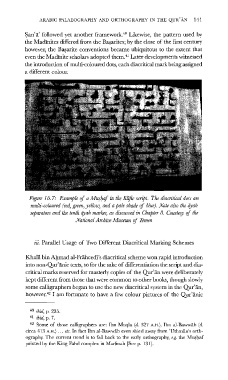
                            the introduction of multi-coloured dots, each diacritical mark being assigned
                            a different colour.


                              Figure 10.7: Example if a Mu~bqf in the KUfic script. The diacritical dots are
                              multi-coloured (red, green, yellow, andapaleshade if blue). Notealso the ayah
                              separators and the tenth ayah marker, as discussed in Chapter 8. Courtesy if the
                                              National Archive Museum if Yemen


                                iii. Parallel Usage of Two Different Diacritical Marking Schemes

                             Khalil bin Ahmad al-Fraheedi's diacritical scheme won rapid introduction
                             into non-Qur'anic texts, so for the sake of differentiation the script and dia-
                             critical marks reserved for masterly copies of the Qur'an were deliberately
                             kept different from those that were common to other books, though slowly
                             some calligraphers began to use the new diacritical system in the Qur'an,
                             however.'? I am fortunate to have a few colour pictures of the Qjir'anic

                              +0 ibid, p. 235.
                              41 ibid, p. 7.
                              42 Some of those calligraphers are: Ibn Muqla (d. 327 A.H.), Ibn al-Bawwab (d.
                             circa 413 A.H.) ... etc. In fact Ibn al-Bawwab even shied away from 'Uthman's orth-
                             ography. The current trend is to fall back to the early orthography, e.g. the Mushaf
                             printed by the King Fahd complex in Madinah [See p. 131].

