


Page 156 - History of The Quranic Text | Kalamullah.Com
P. 156
136           THE HISTORY OF THE QUR'A"lIC TEXT

                                       j kJ. Known as nuqaial-ijam(i~)/I.k.4;), this system was familiar to
                                       Arabs prior to Islam or, at the latest, in Islam's youth ~ preceding
                                       'Uthman's Mushaf as we will soon demonstrate.
                                    2. Diacritical marks:
                                       Known in Arabic as tashkil (~: i.e. [amma.fatha, kasra) or nuqat
                                       al-i'rab (ylf)/I.k.4;);24these can take the form of dots or more con-
                                       ventional markings, and were invented by Abu al-Aswad ad-Du'ali
                                       (c. 10 B.H. - 69 A.H.l611 - 688 C.E.).25
                                    We will cover both of these schemes at length.


                                             i. Early Arabic Writings and the Skeletal Dots

                                  The rasm ai-khat (lit: the drawing of the script)of the Qur'an in the 'Uthmani
                                  Mushaf does not contain dots to differentiate such characters as b (y), t
                                  (-.:,;), and so on, and neither does it possess diacritical marks such esfatha,
                                  damma, and kasra. There is a good deal of evidence to show that the concept
                                  of skeletal dots was not new to the Arabs, being familiar to them even prior
                                  to Islam. These dots were nevertheless absent from the earliest Mushafs.
                                  Whatever the philosophy behind this may have been,26I willintroduce some
                                  examples to prove that early Arabic palaeography did indeed have dots
                                  to accompany the skeleton of the characters.
                                    1. The Raqush tombstone, the oldest dated pre-Islamic Arabic inscrip-
                                        tion, c. 267 C.E., contains dots on the letters dhal, ra' and shin."
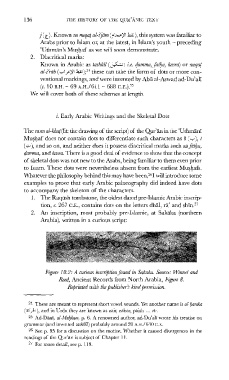
                                    2. An inscription, most probably pre-Islamic, at Sakaka (northern
                                       Arabia), written in a curious script:


                                         Figure 10.2:A curious inscriptionfoundin Sakaka. Source: Winnet and
                                              Reed, Ancient Records from North Arabia, Figure 8.
                                                 Reprinted with the publisher's kindpermission.

                                   21 These are meant to represent short vowel sounds. Yet another name is al-haraka
                                  (;;S.}-I), and in Urdu they are known as zair, zabar, paish ... etc.
                                   25 Ad-Dani, al-Muhkam, p. 6. A renowned author, ad-Du'ali wrote his treatise on
                                  grammar (and invented tashkzl) probably around 20 A.H./640 C.B.
                                   26 See p. 95 for a discussion on the motive. Whether it caused divergences in the
                                  readings of the Qur'an is subject of Chapter 11.
                                   27 For more detail, see p. 119.

