


Page 157 - History of The Quranic Text | Kalamullah.Com
P. 157
ARABIC PALAEOGRAPHY AND ORTHOGRAPHY IN THE QUR'AN    137

                                 The inscription (supposedly a combination of Nabataean and Arabic
                                 charactersj" contains dots associated with the following Arabic letters:
                                 n (0), b(y) and t (u).
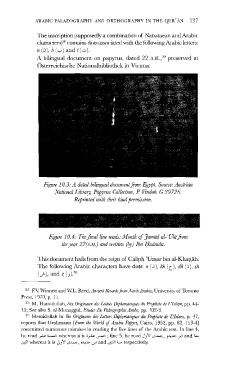
                             3. A bilingual document on papyrus, dated 22 A.H.,29 preserved at
                                 Osterreichische Nationalbibliothek in Vienna:


                                   Figure 10.3:A dated bilingual document.from Egypt. Source: Austrian
                                       National Library, Papyrus Collection, P. Vindob. G 39726.
                                             Reprinted withtheir kindpermission.


                                     Figure 10.4: Thejinalline reads: Month qf Jamiid al-Uld from
                                         theyear22(A.H.) andwritten (by) IbnHudaida.

                                 This document hails from the reign of Caliph 'Umar bin al-Khattab.
                                 The following Arabic characters have dots: n (0), kit(t), dh (~), sh
                                 (cJ~)' and Z (j).30


                             28 EV Winnett and WL. Reed, Ancient Recordsfiom North Arabia, University of Toronto
                           Press, 1970, p. 11.
                             29 M. Hamidullah, Six Originaux des Lettres Diplomatiques duProphete deL'Islam,pp. 44-
                           45; See also S. al-Munaggid, Etudes De Paleographie Arabe, pp. 102-3.
                             30 Hamidullah in Six Originaux des Leiires Diplomatiques du Prophete de L'!slam, p. 47,
                           reports that Grohmann [From the T110rld qf ArabicPapyri, Cairo, 1952, pp. 62, 113-4]
                           committed numerous mistakes in reading the five lines of the Arabic text. In line 4,
                           he read ~ 'J.-...>. whereas it is i~ c.r->- ; line 5, he read JJ\rI ($..L...",-, J..\;J.>. 0<\ and c.-
                           ~I whereas it is JJ\rI ($..L...",-, '..\;J.>.0<\ and 0P1 L.o respectively.

