


Page 176 - History of The Quranic Text | Kalamullah.Com
P. 176
156            THE HISTORY OF THE QUR'ANIC TEXT

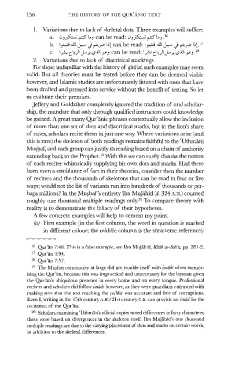
                                    1. Variations due to lack of skeletal dots. Three examples will suffice:
                                          a.  0--'~ r-=5 L.--' can be read: 0--'~ r-=5 L.--' .16
                                          b. IH .JJ\ ~ J rr'=' I~l can be read: Ip .J.l\ ~ J rr'=' \~1.17
                                          c.  \~ C~)\ J--.I- (,$.iJ\ r --' can be read: Ir-' c~)IJ.-.I- (,$.iJ1 r --' .18
                                    2. Variations due to lack of diacritical markings.
                                    For those unfamiliar with the history of quii'at,such examples may seem
                                  valid. But all theories must be tested before they can be deemed viable
                                  however, and Islamic studies are unfortunately littered with ones that have
                                  been drafted and pressed into service without the benefit of testing. So let
                                  us evaluate their premises.
                                    Jeffery and Go1dziher completely ignored the tradition of oral scholar-
                                  ship, the mandate that only through qualified instructors could knowledge
                                  be gained. A great many Qjir'anic phrases contextually allow the inclusion
                                  of more than one set of dots and diacritical marks, but in the lion's share
                                  of cases, scholars recite them injust one way. Where variations arise (and
                                  this is rare) the skeleton of both readings remains faithful to the 'Uthmani
                                  Mushaf and each group can justily itsreading based on a chain of authority
                                  extending back to the Prophet. 19 With this we can easily dismiss the notion
                                  of each reciter whimsically supplying his own dots and marks. Had there
                                  been even a semblance of fact in their theories, consider then the number
                                  of reciters and the thousands of skeletons that can be read in four or five
                                  ways; would not the list of variants run into hundreds of thousands or per-
                                  haps millions? In the Mushaf's entirety Ibn Mujahid (d. 324 A.H.) counted
                                  roughly one thousand multiple readings only.20 To compare theory with
                                  reality is to demonstrate the fallacy of their hypotheses.
                                    A few concrete examples will help to cement my point.
                                     (aJ First example (in the first column, the word in question is marked
                                        in different colour; the middle column is the sura.verse reference):

                                    16 Qur'an 7:48. This is a false example, see Ibn Mujahid, Kitiib as-Sab'a, pp. 281-2.
                                    17 Qur'an 4:94.
                                    18 Qur'an 7:57.
                                    19 The Muslim community at large did not trouble itself with isniids when memor-
                                  ising the Qur'an, because this was impractical and unnecessary for the layman given
                                  the Qur'an's ubiquitous presence in every horne and on every tongue. Professional
                                  reciters and scholars did follow isniids however, as they were guardians entrusted with
                                  making sure that the text reaching the public was accurate and free of corruptions.
                                  Even I, writing in the 15th century A.H.l21 st century C.E. can provide an isniid for the
                                  recitation of the Qur'an.
                                    20 Scholars examining 'Uthrnan's officialcopies noted differences in forty characters;
                                  these were based on divergences in the skeleton itself. Ibn Mujahid's one thousand
                                  multiple readings are due to the varying placement of dots and marks on certain words,
                                  in addition to the skeletal differences.

