


Page 178 - History of The Quranic Text | Kalamullah.Com
P. 178
158           THE HISTORY OF THE QUR'A.NIC TEXT


                                           I"": .  • t
                                               ~      -....;.)
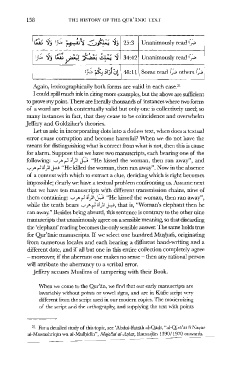
                                    ~ ~j :fiO      ..~  -~ -   ~j 25:3   Unanimously read ,:;..,
                                     I~ ~j ~ ~ j:.';;,; J.u.:.; ~ 34:42 Unanimously read I:;'"
                                     J             ..,   ... ..
                                                      1<..  ,;)1'        Some read (,:.. others G:..
                                                      <' ~' s, 1• I
                                                      ~    .:  J \)}  48:11
                                    Again, lexicographically both forms are valid in each case."
                                    I could spillmuch ink in citing more examples, but the above are sufficient
                                  to provemy point. There are literallythousands of instanceswhere twoforms
                                  of a word are both contextually valid but only one is collectively used; so
                                  many instances in fact, that they cease to be coincidence and overwhehn
                                 Jeffery and Goldziher's theories.
                                    Let us ask: in incorporating dots into a dotless text, when does a textual
                                  error cause corruption and become harmful? When we do not have the
                                  means for distinguishing what is correct from what is not, then this is cause
                                  for alarm. Suppose that we have two manuscripts, each bearing one of the
                                  following: y f' ~ oi}1 p  "He kissed the woman, then ran away", and
                                  y f' ~ (1)1 j.;:J "He killed the woman, then ran away". Now in the absence
                                  of a context with which to extract a clue, deciding which is right becomes
                                  impossible; clearly we have a textual problem confronting us. Assume next
                                  that we have ten manuscripts with different transmission chains, nine of
                                  them containing: y f' ~ 01)\P "He kissed the woman, then ran away",
                                  while the tenth bears Y.T'~ oi)1 j.."J, that is, "Woman's elephant then he
                                  ran away." Besides being absurd, this sentence is contrary to the other nine
                                  manuscripts that unanimously agree on a sensiblemeaning, so that discarding
                                  the 'elephant' reading becomes the only sensibleanswer.The same holdstrue
                                  for Qur'anic manuscripts. If we select one hundred Mushafs, originating
                                  from numerous locales and each bearing a different hand-writing and a
                                  different date, and if all but one in this entire collection completely agree
                                  - moreover, if the aberrant one makes no sense - then any rational person
                                  will attribute the aberrancy to a scribal error.
                                    Jeffery accuses Muslims of tampering with their Book.

                                      When we come to the Qur'an, we fmd that our early manuscriptsare
                                      invariably without points or vowel signs, and are in Kufic script very
                                      different fromthe scriptusedin our modern copies. The modernizing
                                      of the script and the orthography, and supplying the text with points


                                   2\ Fora detailed study of thistopic, see 'Abdul-Fattah a1-Qa<;II, "al-Qjra'at fi:Nazar
                                  al-Mustashriqin wa al-Mulhidtn", MaJaliat ai-Arhar, Ramadan 1390/1970 onwards.

