


Page 55 - Ulum Al Quran An Introduction To The Sciences Of The Quran
P. 55
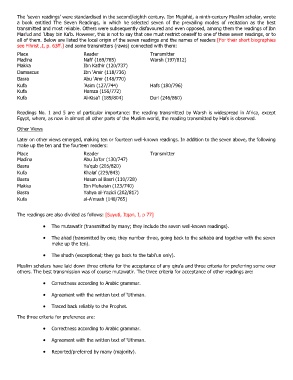
The 'seven readings' were standardised in the second/eighth century. Ibn Mujahid, a ninth-century Muslim scholar, wrote
a book entitled The Seven Readings, in which he selected seven of the prevailing modes of recitation as the best
transmitted and most reliable. Others were subsequently disfavoured and even opposed, among them the readings of Ibn
Mas'ud and 'Ubay bin Ka'b. However, this is not to say that one must restrict oneself to one of these seven readings, or to
all of them. Below are listed the local origin of the seven readings and the names of readers [For their short biographies
see Fihrist ,I, p. 63ff.] and some transmitters (rawis) connected with them:
Place Reader Transmitter
Madina Nafi' (169/785) Warsh (197/812)
Makka Ibn Kathir (120/737)
Damascus Ibn 'Amir (118/736)
Basra Abu 'Amr (148/770)
Kufa 'Asim (127/744) Hafs (180/796)
Kufa Hamza (156/772)
Kufa Al-Kisa'i (189/804) Duri (246/860)
Readings No. 1 and 5 are of particular importance: the reading transmitted by Warsh is widespread in Africa, except
Egypt, where, as now in almost all other parts of the Muslim world, the reading transmitted by Hafs is observed.
Other Views
Later on other views emerged, making ten or fourteen well-known readings. In addition to the seven above, the following
make up the ten and the fourteen readers:
Place Reader Transmitter
Madina Abu Ja'far (130/747)
Basra Ya'qub (205/820)
Kufa Khalaf (229/843)
Basra Hasan al Basri (110/728)
Makka Ibn Muhaisin (123/740)
Basra Yahya al-Yazidi (202/817)
Kufa al-A'mash (148/765)
The readings are also divided as follows: [Suyuti, Itqan, I, p 77]
The mutawatir (transmitted by many; they include the seven well-known readings).
The ahad (transmitted by one; they number three, going back to the sahaba and together with the seven
make up the ten).
The shadh (exceptional; they go back to the tabi'un only).
Muslim scholars have laid down three criteria for the acceptance of any qira'a and three criteria for preferring some over
others. The best transmission was of course mutawatir. The three criteria for acceptance of other readings are:
Correctness according to Arabic grammar.
Agreement with the written text of 'Uthman.
Traced back reliably to the Prophet.
The three criteria for preference are:
Correctness according to Arabic grammar.
Agreement with the written text of 'Uthman.
Reported/preferred by many (majority).

