


Page 149 - Tafsir of surat at tawba repentance
P. 149
© Islamic Online University Usool at-Tafseer
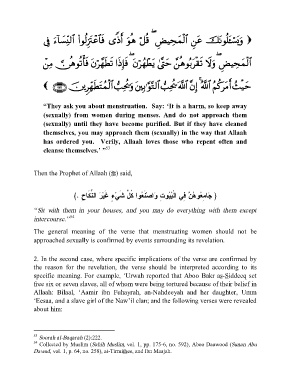
Îû uä!$|¡ÏiY9$# (#qä9ÍtIôã$$sù ]r& uqèd ö@è% ( ÇÙÅsyJø9$# Ç`tã tRqè=t«ó¡our )
ô`ÏB Æèdqè?ù'sù tbö£gsÜs? #sÎ*sù ( tbößgôÜt 4Ó®Lym £`èdqç/tø)s? wur ( ÇÙÅsyJø9$#
( ÇËËËÈ úïÌÎdgsÜtFßJø9$# =Ïtäur tûüÎ/º§qG9$# =Ïtä ©!$# ¨bÎ) 4 ª!$# ãNä.ttBr& ß]øym
“They ask you about menstruation. Say: ‘It is a harm, so keep away
(sexually) from women during menses. And do not approach them
(sexually) until they have become purified. But if they have cleaned
themselves, you may approach them (sexually) in the way that Allaah
has ordered you. Verily, Allaah loves those who repent often and
53
cleanse themselves.’ ”
Then the Prophet of Allaah (r) said,
(. ِﺡﺎﹶﻜﱢﻨﻟﺍ ﺭﻴﹶﻏ ٍﺀﻲ ﹶ ﺸ ﱠلﹸﻜ ﺍﻭﻌﹶﻨﺼﺍﻭ ِﺕﻭﻴﺒﹾﻟﺍ ﻲِﻓ ﻥﻫﻭﻌِﻤﺎﺠ )
“Sit with them in your houses, and you may do everything with them except
54
intercourse.”
The general meaning of the verse that menstruating women should not be
approached sexually is confirmed by events surrounding its revelation.
2. In the second case, where specific implications of the verse are confirmed by
the reason for the revelation, the verse should be interpreted according to its
specific meaning. For example, ‘Urwah reported that Aboo Bakr as-Siddeeq set
free six or seven slaves, all of whom were being tortured because of their belief in
Allaah: Bilaal, ‘Aamir ibn Fuhayrah, an-Nahdeeyah and her daughter, Umm
‘Eesaa, and a slave girl of the Naw’il clan; and the following verses were revealed
about him:
53
Soorah al-Baqarah (2):222.
54
Collected by Muslim (Sahih Muslim, vol. 1, pp. 175-6, no. 592), Aboo Daawood (Sunan Abu
Dawud, vol. 1, p. 64, no. 258), at-Tirmithee, and Ibn Maajah.
http://www.islamiconlineuniversity.com 30

