


Page 150 - Tafsir of surat at tawba repentance
P. 150
© Islamic Online University Usool at-Tafseer
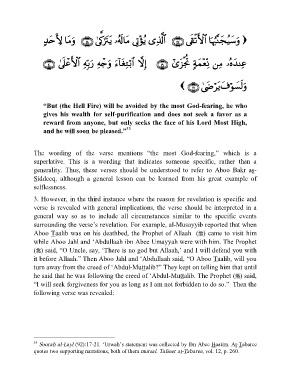
>tnL{ $tBur ÇÊÑÈ 4ª1utIt ¼ã&s!$tB ÎA÷sã Ï%©!$# ÇÊÐÈ s+ø?F{$# $pkâ:¨Zyfãyur )
ÇËÉÈ 4n?ôãF{$# ÏmÎn/u Ïmô`ur uä!$tóÏGö/$# wÎ) ÇÊÒÈ #tøgéB 7pyJ÷èÏoR `ÏB ¼çnyYÏã
( ÇËÊÈ 4ÓyÌöt t$öq|¡s9ur
“But (the Hell Fire) will be avoided by the most God-fearing, he who
gives his wealth for self-purification and does not seek a favor as a
reward from anyone, but only seeks the face of his Lord Most High,
55
and he will soon be pleased.”
The wording of the verse mentions “the most God-fearing,” which is a
superlative. This is a wording that indicates someone specific, rather than a
generality. Thus, these verses should be understood to refer to Aboo Bakr as-
Siddeeq, although a general lesson can be learned from his great example of
selflessness.
3. However, in the third instance where the reason for revelation is specific and
verse is revealed with general implications, the verse should be interpreted in a
general way so as to include all circumstances similar to the specific events
surrounding the verse’s revelation. For example, al-Musayyib reported that when
Aboo Taalib was on his deathbed, the Prophet of Allaah (r) came to visit him
while Aboo Jahl and ‘Abdullaah ibn Abee Umayyah were with him. The Prophet
(r) said, “O Uncle, say, ‘There is no god but Allaah,’ and I will defend you with
it before Allaah.” Then Aboo Jahl and ‘Abdullaah said, “O Aboo Taalib, will you
turn away from the creed of ‘Abdul-Muttalib?” They kept on telling him that until
he said that he was following the creed of ‘Abdul-Muttalib. The Prophet (r) said,
“I will seek forgiveness for you as long as I am not forbidden to do so.” Then the
following verse was revealed:
55
Soorah al-Layl (92):17-21. ‘Urwah’s statement was collected by Ibn Abee Haatim. At-Tabaree
quotes two supporting narrations, both of them mursal. Tafseer at-Tabaree, vol. 12, p. 260.
http://www.islamiconlineuniversity.com 31

