


Page 169 - Tafsir of surat at tawba repentance
P. 169
© Islamic Online University Usool at-Tafseer
“I used to forbid you from visiting graves, but (now) you should visit them, as
24
surely they are reminders (of the next life).”
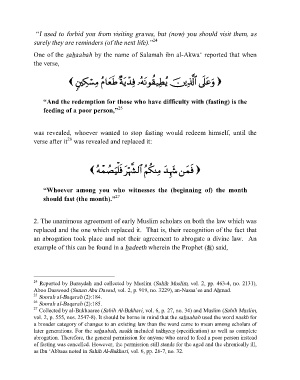
One of the sahaabah by the name of Salamah ibn al-Akwa‘ reported that when
the verse,
( &ûüÅ3ó¡ÏB ãP$yèsÛ ×ptôÏù ¼çmtRqà)ÏÜã úïÏ%©!$# n?tãur )
“And the redemption for those who have difficulty with (fasting) is the
25
feeding of a poor person,”
was revealed, whoever wanted to stop fasting would redeem himself, until the
26
verse after it was revealed and replaced it:
( çmôJÝÁuù=sù tök¤¶9$# ãNä3YÏB yÍky `yJsù )
“Whoever among you who witnesses the (beginning of) the month
27
should fast (the month).”
2. The unanimous agreement of early Muslim scholars on both the law which was
replaced and the one which replaced it. That is, their recognition of the fact that
an abrogation took place and not their agreement to abrogate a divine law. An
example of this can be found in a hadeeth wherein the Prophet (r) said,
24
Reported by Buraydah and collected by Muslim (Sahih Muslim, vol. 2, pp. 463-4, no. 2131),
Aboo Daawood (Sunan Abu Dawud, vol. 2, p. 919, no. 3229), an-Nasaa’ee and Ahmad.
25
Soorah al-Baqarah (2):184.
26
Soorah al-Baqarah (2):185.
27
Collected by al-Bukhaaree (Sahih Al-Bukhari, vol. 6, p. 27, no. 34) and Muslim (Sahih Muslim,
vol. 2, p. 555, nos. 2547-8). It should be borne in mind that the sahaabah used the word naskh for
a broader category of changes to an existing law than the word came to mean among scholars of
later generations. For the sahaabah, naskh included takhsees (specification) as well as complete
abrogation. Therefore, the general permission for anyone who cared to feed a poor person instead
of fasting was cancelled. However, the permission still stands for the aged and the chronically ill,
as Ibn ‘Abbaas noted in Sahih Al-Bukhari, vol. 6, pp. 26-7, no. 32.
http://www.islamiconlineuniversity.com 19

