


Page 173 - Tafsir of surat at tawba repentance
P. 173
© Islamic Online University Usool at-Tafseer
“So turn your face toward al-Masjid al-Haraam (Makkah) and
38
wherever you all may be, turn your faces toward it.”
The Prophet’s wife ‘Aa’ishah also reported that the fasting of ‘Aashooraa’ (the
10th of the month of Muharram) used to be compulsory until the verses of
Ramadaan were revealed. After that, whoever wished to fast ‘Aashooraa’ did
39
so. When the Prophet (r) migrated to Madeenah, he found the Jews fasting on
that day in commemoration of Prophet Moosaa’s deliverance from Pharaoh in
Egypt. The Prophet (r), under divine guidance, ordered the Muslims to do so
also, but no Qur’aanic revelation was revealed concerning it. However, during the
second year after the Hijrah, Allaah revealed the following verse,
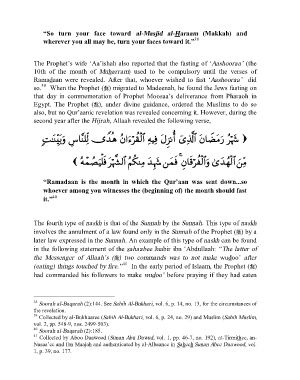
;M»oYÉit/ur Ĩ$¨Y=Ïj9 Wèd ãb#uäöà)ø9$# ÏmÏù tAÌRé& üÏ%©!$# tb$ÒtBu ãöky )
( çmôJÝÁuù=sù tök¤¶9$# ãNä3YÏB yÍky `yJsù 4 Èb$s%öàÿø9$#ur 3yßgø9$# z`ÏiB
“Ramadaan is the month in which the Qur’aan was sent down...so
whoever among you witnesses the (beginning of) the month should fast
40
it.”
The fourth type of naskh is that of the Sunnah by the Sunnah. This type of naskh
involves the annulment of a law found only in the Sunnah of the Prophet (r) by a
later law expressed in the Sunnah. An example of this type of naskh can be found
in the following statement of the sahaabee Jaabir ibn ‘Abdullaah: “The latter of
the Messenger of Allaah’s (r) two commands was to not make wudoo’ after
41
(eating) things touched by fire.” In the early period of Islaam, the Prophet (r)
had commanded his followers to make wudoo’ before praying if they had eaten
38
Soorah al-Baqarah (2):144. See Sahih Al-Bukhari, vol. 6, p. 14, no. 13, for the circumstances of
the revelation.
39
Collected by al-Bukhaaree (Sahih Al-Bukhari, vol. 6, p. 24, no. 29) and Muslim (Sahih Muslim,
vol. 2, pp. 548-9, nos. 2499-503).
40
Soorah al-Baqarah (2):185.
41
Collected by Aboo Daawood (Sunan Abu Dawud, vol. 1, pp. 46-7, no. 192), at-Tirmithee, an-
Nasaa’ee and Ibn Maajah and authenticated by al-Albaanee in Saheeh Sunan Abee Daawood, vol.
1, p. 39, no. 177.
http://www.islamiconlineuniversity.com 23

