


Page 170 - Tafsir of surat at tawba repentance
P. 170
© Islamic Online University Usool at-Tafseer
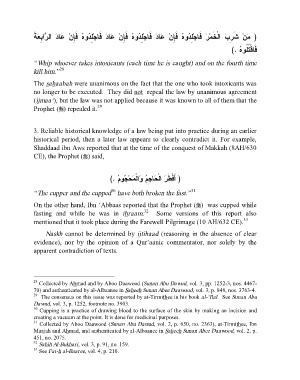
ﹶﺔﻌِﺒﺍﺭﻟﺍ ﺩﺎﻋ ﻥِﺈﹶﻓ ﻩﻭﺩِﻠﺠﺎﹶﻓ ﺩﺎﻋ ﻥِﺈﹶﻓ ﻩﻭﺩِﻠﺠﺎﹶﻓ ﺩﺎﻋ ﻥِﺈﹶﻓ ﻩﻭﺩِﻠﺠﺎﹶﻓ ﺭﻤﹶﺨﹾﻟﺍ ﺏِﺭﹶﺸ ﻥﻤ )
(. ﻩﻭﹸﻠﹸﺘﹾﻗﺎﹶﻓ
“Whip whoever takes intoxicants (each time he is caught) and on the fourth time
28
kill him.”
The sahaabah were unanimous on the fact that the one who took intoxicants was
no longer to be executed. They did not repeal the law by unanimous agreement
(ijmaa‘), but the law was not applied because it was known to all of them that the
29
Prophet (r) repealed it.
3. Reliable historical knowledge of a law being put into practice during an earlier
historical period, then a later law appears to clearly contradict it. For example,
Shaddaad ibn Aws reported that at the time of the conquest of Makkah (8AH/630
CE), the Prophet (r) said,
(. ﻡﻭﺠﺤﻤﹾﻟﺍﻭ ﻡِﺠﺎﺤﹾﻟﺍ ﺭﹶﻁﹾﻓَﺃ )
31
30
“The cupper and the cupped have both broken the fast.”
On the other hand, Ibn ‘Abbaas reported that the Prophet (r) was cupped while
fasting and while he was in ihraam. 32 Some versions of this report also
33
mentioned that it took place during the Farewell Pilgrimage (10 AH/632 CE).
Naskh cannot be determined by ijtihaad (reasoning in the absence of clear
evidence), nor by the opinion of a Qur’aanic commentator, nor solely by the
apparent contradiction of texts.
28
Collected by Ahmad and by Aboo Daawood (Sunan Abu Dawud, vol. 3, pp. 1252-3, nos. 4467-
70) and authenticated by al-Albaanee in Saheeh Sunan Abee Daawood, vol. 3, p. 848, nos. 3763-4.
29
The consensus on this issue was reported by at-Tirmithee in his book al-‘Ilal. See Sunan Abu
Dawud, vol. 3, p. 1252, footnote no. 3903.
30
Cupping is a practice of drawing blood to the surface of the skin by making an incision and
creating a vacuum at the point. It is done for medicinal purposes.
31
Collected by Aboo Daawood (Sunan Abu Dawud, vol. 2, p. 650, no. 2363), at-Tirmithee, Ibn
Maajah and Ahmad, and authenticated by al-Albaanee in Saheeh Sunan Abee Daawood, vol. 2, p.
451, no. 2075.
32
Sahih Al-Bukhari, vol. 3, p. 91, no. 159.
33
See Fat-h al-Baaree, vol. 4, p. 210.
http://www.islamiconlineuniversity.com 20

