


Page 175 - Tafsir of surat at tawba repentance
P. 175
© Islamic Online University Usool at-Tafseer
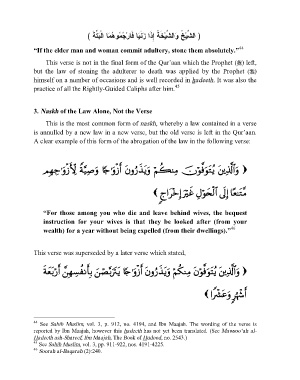
( ﹶﺔﱠﺘﺒﹾﻟﺍ ﺎﻤﻫﻭﻤﺠﺭﺎﹶﻓ ﺎﻴﹶﻨﺯ ﺍﹶﺫِﺇ ﹸﺔﹶﺨﻴﱠﺸﻟﺍﻭ ﹸﺦﻴﱠﺸﻟﺍ )
44
“If the elder man and woman commit adultery, stone them absolutely.”
This verse is not in the final form of the Qur’aan which the Prophet (r) left,
but the law of stoning the adulterer to death was applied by the Prophet (r)
himself on a number of occasions and is well recorded in hadeeth. It was also the
45
practice of all the Rightly-Guided Caliphs after him.
3. Naskh of the Law Alone, Not the Verse
This is the most common form of naskh, whereby a law contained in a verse
is annulled by a new law in a new verse, but the old verse is left in the Qur’aan.
A clear example of this form of the abrogation of the law in the following verse:
OÎgÅ_ºurøX{ Zp§Ï¹ur %[`ºurør& tbrâxtur öNà6YÏB cöq©ùuqtGã tûïÏ%©!$#ur )
( 8l#t÷zÎ) uöxî ÉAöqyÛø9$# n<Î) $·è»tG¨B
“For those among you who die and leave behind wives, the bequest
instruction for your wives is that they be looked after (from your
46
wealth) for a year without being expelled (from their dwellings).”
This verse was superseded by a later verse which stated,
spyèt/ör& £`ÎgÅ¡àÿRr'Î/ z`óÁ/utIt %[`ºurør& tbrâxtur öNä3ZÏB tböq©ùuqtFã tûïÏ%©!$#ur )
( #Zô³tãur 9åkôr&
44
See Sahih Muslim, vol. 3, p. 912, no. 4194, and Ibn Maajah. The wording of the verse is
reported by Ibn Maajah, however this hadeeth has not yet been translated. (See Mawsoo‘ah al-
Hadeeth ash-Shareef, Ibn Maajah, The Book of Hudood, no. 2543.)
45
See Sahih Muslim, vol. 3, pp. 911-922, nos. 4191-4225.
46
Soorah al-Baqarah (2):240.
http://www.islamiconlineuniversity.com 25

